Operating a Personal Service Setting

Ottawa Public Health (OPH) is committed to working with new and existing personal service setting business owners to prioritize the health and safety of patrons and employees. Personal services settings (PSS) refers to settings in which aesthetic services are delivered, such as but not limited to:

  • Manicures and pedicures
  • Body piercing and ear lobe piercing
  • Waxing and facials
  • Hairstyling and barbering
  • Tattooing and micro-blading
  • Body modification, such as branding or scarification.
  • Electrolysis and laser hair removal
  • Microdermabrasion

The Ontario Personal Service Setting (PSS) Regulation 136/18 has been developed by the Ministry of Health and Long Term Care (MOHLTC). Please visit the MOHLTC's website to see how the PSS regulation 136/18 applies to your business and the services that you offer.

If you have any questions or concerns about the regulation and how it applies to you, please contact your public health inspector or Ottawa Public Health at 613-580-6744.

Notify OPH of opening, renovating or relocating a personal services setting business

Prior to opening, renovating, or relocating a Personal Services Setting business, owner/operators are required to submit an electronic copy of floor plans indicating all sinks, reprocessing areas, food and beverage preparation areas, and storage areas (equipment and sinks labelled) to OPH for review and approval.   

Owners/operators are also required to notify OPH, prior to adding new services to ensure that the business is equipped with the service specific requirements.  

In accordance with the Personal Service Settings, O Reg 136/18, please complete the Personal Services Setting Notification and Plan Review Form below at least 14 days before commencing the operation.  

Should you have any questions, please contact OPH to speak with a public health inspector at 613-580-6744. 

What is a Personal Services Setting (PSS)

As part of its mandate under the Ontario Public Health Standards, 2018 and the Infection Prevention and Control Protocol, 2019, Ottawa Public Health (OPH) inspects Personal Services Settings (PSS) to monitor infection prevention and control practices. Our objective is to minimize the risk of blood-borne/other types of infections during the delivery of personal services. PSS refer to settings in which aesthetic services are delivered, such as but not limited to:

  • Manicures and pedicures
  • Body piercing and ear lobe piercing
  • Waxing and facials
  • Hairstyling and barbering
  • Tattooing and micro-blading
  • Body modification, such as branding or scarification.
  • Electrolysis and laser hair removal
  • Microdermabrasion

Public Health Inspectors (PHIs) at Ottawa Public Health (OPH) routinely inspect these establishments to ensure that services are delivered in accordance with the Ministry of Health's Ontario Regulation 136/18: Personal Services Settings to prevent the spread of infections such as blood-borne or fungal.

It is important that your business comply with the new Ontario regulation for Personal Service Settings that was enacted in 2018 (Ontario Regulation 136/18) and Public Health Ontario’s Guide to Infection Prevention and Control in Personal Service Settings, 3rd edition. Both this regulation and the guide are meant to help you prevent your clients from getting infections in your establishment. 

Ottawa Public Health would like to remind you of five important principles outlined in the regulation and guide that could present an infections disease risk to your clients if not followed:

  1. Always clean and disinfect or sterilize reusable equipment after each use.
  2. Use approved disinfectants correctly in your personal service setting.

  3. Discard single use equipment immediately after use and never reused these items.

  4. Provide adequate counter space for reprocessing of your reusable equipment, including a designated sink to assist you in this process. This area is not be used for other purposes.
  5. Ensure that any sterilizers you use meet the standards established by Health Canada and the Canadian Standards Association.

OPH would also like to bring to your attention that collection of client records (name and contact information) is also a requirement under the new regulation.

Contact Ottawa Public Health

Before opening a new business or taking over an existing business, contact Ottawa Public Health at least 14 day before commencing operation at (613-580-6744). Provide the name and address of your business and details of the types of services that will be offered.  At this time, you will be asked to provide copies of your floor plan if possible.

Get a copy of the O. Reg. 136/18: Personal Service Setting, Public Health Ontario’s Guide to Infection Prevention and Control in Personal Service Settings, 3rd edition and Ottawa Public Health resources to ensure that you are able to meet the infection prevention and control requirements. 

Workers' responsibilities

Workers are required to comply with Infection Prevention and Control (IPAC) procedures O. Reg. 136/18: Personal Service Setting while performing services and when using sharps. Routine practices such as hand washing, glove use, and sometimes face protection, are in place to prevent and control the transmission of infections where required.

General requirements

Your business must be:

  • Clean, well lit and kept in good repair.
  • All surfaces such as (counters, tables, trays, lamps, magnifiers) and shelving units in storage areas must be smooth, non-absorbent and easily cleanable.
  • All floors, walls and ceiling must be non-absorbent, clean and in good repair.
  • Reusable instruments must be stored in a clean container and kept separate from dirty instruments and equipment
  • Clean instruments and equipment must be stored separately from dirty instruments and equipment.
  • Single use disposable instruments must be disposed of in a proper manner and immediately after use
  • No double dipping!

Cleaning and disinfecting and sterilization

All work surfaces must be cleaned and disinfected using at least a low-level disinfectant between each client or as required.  All reusable instruments and equipment must be cleaned and disinfected or sterilized (depending on the service provided) after each use. 

Records

Before providing a personal service, the operator of a personal service setting or the person who will be providing the personal service shall obtain the name and contact information of the person seeking the service. (O. Reg 136/18)

Businesses that offer procedures that break the skin such as ear piercing, body piercing, tattooing, micropigmentation, electrolysis and acupuncture, must keep records on-site and accessible. These records include:

  • Date of procedure
  • Which procedure was done and part of the body procedure was done
  • Name and contact info of the client
  • Lot numbers and expiry dates for for pre-packaged sterile equipment used
  • Confirm that an explanation of the procedure and information about any risks associated with the procedure was completed

Additional records that must be kept may include (if applicable) sterilization records, disinfection records and accidental exposures to blood and bodily fluids.

All records must be kept on-site for a minimum of one year and on file for a minimum of two years.

Instruments and equipment

All instruments and equipment must be durable, in good repair and stored in a sanitary manner to avoid contamination.  Don’t forget that any instruments or equipment that are handled or used during a procedure are considered contaminated.

  • Single-use items and instruments made from absorbent material such as foam, paper, wood, etc. thatcannot be adequately cleaned and disinfected must be thrown out immediately after each client use.
  • Re-usable instruments or equipment made from non- absorbent materials such as surgical stainless steel, fiberglass, plastic etc., are able to withstand repeated cleaning and disinfection or sterilization between uses.

If your business uses sharps, i.e. needles, lancets, razors, etc. items must be maintained sterile until point of use, handled minimally and disposed of in an approved sharps container immediately after use.

Sinks

Your business must be equipped with two sinks, one for reprocessing  instruments and one for hand washing.

All handwashing sinks must have:

  • A supply of liquid soap and single-use hand towels (cloth or paper) in dispensers.

All sinks must have:

  • A constant supply of hot and cold running water under pressure must always be available at all sinks.

Sterilization equipment

Some instruments that come into contact with items that are used to break the skin such equipment used in body piercing, and tattooing (i.e. open ended receiving tubes, forceps) can be reprocessed using an autoclave. Note: under no circumstances can sharps be reprocessed. It is your responsibility to make sure that the sterilization monitoring requirements outlined in the O. Reg. 136/18: Personal Service Setting are followed at all times.

Laundry requirements

All laundered items must be stored in a manner to prevent contamination and kept separate from dirty or used linens.

  • Towels and linens can be laundered on-site or by a licensed laundry service.
  • All linens, towels or sheets used during a service must be laundered before you can reuse them. Use the hot water setting in the washing machine and the hot air setting in the dryer.

There are many ways that blood-borne infections can be spread in PSS. Here are some common examples:

  • Using dirty instruments.
  • Not cleaning and disinfecting instruments and equipment properly after each client.
  • Reusing single-use items, such as acupuncture needles or blades.
  • A worker accidentally pokes themselves with a used needle or a sharp instrument.
  • Blood or body fluids come in contact with an open wound or cut. This could happen during a manicure or pedicure or when removing a blackhead or pimple.
  • A splash or spray from blood or body fluids during a nose piercing or waxing gets into a worker eyes or mouth.

An instrument may look clean, but micro-organisms that can cause infection can still be present. Proper cleaning and disinfection is necessary.

You can be spreading hepatitis B or C virus without even knowing it. Protect yourself and your clients by washing your hands and practicing proper cleaning and disinfection and/or sterilization of instruments, equipment and work surfaces.

Clients that may be infected with HIV, hepatitis B or C do not have to tell you they have a blood-borne disease.

  • Protect yourself from hepatitis B – Get vaccinated.
  • Hepatitis B can survive on surfaces like metal, glass and workstations for up to 10 days.
  • Hepatitis C can survive on surfaces for up to four days!

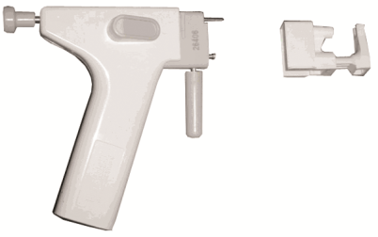
Mechanical ear piercing guns, instruments or other devices insert earrings by use of "spring-loaded" devices or models that are squeezed by hand pressure. Please note that the intended use of these devices is only for the lobe or fleshy part of the ear.

ear piercing gun

These devices are not suitable for piercing other parts of the body such as the navel, the nasal cartilage, or the cartilage areas of the ear. The action of the earlobe piercing gun can damage tissue and create a risk for infection later. (Health Canada, 1999)

Certain services are now prohibited under O. Reg. 136/18: Personal Service Setting these include:

  • Ear candling or coning
  • Any personal service involving live aquatic species, including fish pedicures.

In addition, under the Health Protection and Promotion Act no person, other than a regulated health professional, sells, offers for sale or provides

  • Scleral tattooing (tattooing of the eye).
  • Implantation of eye jewellery under the conjunctiva.

Information Update:

September 13, 2019: Medical devices must be approved by Health Canada, including needle-free dermal filler devices used for cosmetic skin treatments, these devices are not authorized in Canada and may pose health risks.

“To date, Health Canada has not licenced any needle-free dermal filler devices in Canada as manufacturers of these devices have not provided safety, quality and supporting clinical effectiveness data for Health Canada’s review and consideration. Labels and instructions have also not been reviewed.”

Additional information can be found by visiting the Health Canada website.

Personal service setting at special events

Special events in the City of Ottawa that offer personal services on-site must comply with all applicable sections of the Health Protection and Promotion Act, Ontario regulation 136/18 Personal Service Settings

Special events include conventions, expos, shows, and fairs. 

These guidelines are intended to be used for special events attended by the general public or industry representatives where personal services are provided, such as: 

  • Hairstyling 
  • Barbering 
  • Tattooing 
  • Micropigmentation 
  • Microblading 
  • Ear piercing 
  • Body piercing 
  • Electrolysis 
  • Manicures 
  • Pedicures 
  • Aesthetics (facials or waxing) 

Special event organizer  

Special Event Organizers must notify OPH by completing and submitting the Special Event Organizer Application Form a minimum of 14 days prior to the event.   

  • The completed application form shall be accompanied by a site plan indicating all areas to be used and the location of all facilities and activities, including the location of:  
  • Vendor setup (indoor/outdoor) 
  • Types of Services that will be offered  
  • Structured vendor handwash stations (needs approval from OPH) 
  • Washrooms 

The event organizer is responsible for ensuring the venue is maintained in a sanitary condition at all times during the event. 

Event Organizer(s) are to ensure all Personal Service Setting vendors submit a Personal Service Setting Special Event Vendor Application Form.  

Special event vendor  

The vendor must fill out the Special Event Vendor Application Form to OPH within 14 business days prior to the event. 

All personal service vendors must ensure that workers at the event are aware of the IPAC requirements and maintain these practices for the services they provide. 

Working environment 

Due to the risk of contamination with the outside environment, OPH does not permit invasive PSS services, such as tattooing and piercing at outdoor special events, except for vendors that have enclosed mobile units.

  • Enclosed mobile units must be in compliance with the Personal Service Settings Regulation. O Reg 136/18, including:
    • sufficient lighting
    • solid walls and hard flooring that is smooth, non-absorbent, and easily cleanable
    • screened windows and doors
    • handwash basin equipped with potable hot and cold running water under pressure with soap and paper towel
    • wastewater collection within the unit and disposed of in a sanitary manner

The event vendor is responsible to ensure their booth is always maintained in a sanitary manner during the event.

  • Each booth area must be well lit to facilitate cleaning and prevent injuries.
  • The booths shall be sectioned off to ensure limited public access where services are being provided. This is to ensure infection prevention and control (IPAC) standards can be maintained. 

Contact surfaces such as counters, trays, and tables must have a smooth and non-absorbent finish to allow for proper cleaning and disinfection. 

Chairs must be made of a material that can be cleaned and disinfected between clients. If chairs must be covered, the cover must be single-use and discarded between clients or cleaned and disinfected between clients. 

Soft surfaces such as grass, sand, gravel and mud require flooring. Acceptable flooring at the event includes: 

  • Plywood 
  • Rubber mats 
  • Pavement  

Hand hygiene  

All personal service workers must perform hand hygiene before service delivery and as required during and after service.    

Requirements for invasive services, such as tattooing and piercing

  • 70 to 90 per cent alcohol-based hand rub will be available at each booth   
  • The structured hand wash station will be located within vendor booth   
  • The structured hand wash station will be accessible during service   
  • The structured hand wash station will be equipped with potable water, soap and paper towel    

Requirements for non-invasive services, such as make-up application and waxing

  • 70 to 90 per cent alcohol-based hand rub will be available at each booth   
  • The structured hand wash station will be available in a convenient location and accessible during service  
  • The structured hand wash station will be equipped with potable water, soap and paper 

Instruments and sterilization   

Reprocessing/sterilization of instruments is not permitted onsite.  

It is recommended to use instruments that are single-use disposable and to bring multiple instrument sets for service on-site.   

For items sterilized at a business location, you must have readily available onsite the name and address of where the items were sterilized. 

For items purchased pre-packaged and sterile, you must have readily available onsite the name/address/telephone number of the supplier(s). 

Any re-usable item must be placed into a covered puncture-resistant, leak-proof container immediately after use. The container will be labelled “Dirty items – do not use”. These items will be brought back to the business location for proper cleaning and disinfection.  

Client and vendor health and safety 

Each vendor must: 

  • have an adequate amount of skin antiseptic and clean, single-use, disposable swabs on-site to cleanse the skin prior to any procedure where skin will be punctured such as tattooing and piercing.  
  • maintain client records for all services provided
  • maintain records of accidental blood and body fluid exposures  
  • provide clients with verbal and written after-care information after all invasive procedures. 
  • not eat, drink or smoke while providing a service. 
  • consider immunization against hepatitis B. This is highly recommended for those providing invasive services.

Cleaning and waste disposal  

Garbage, sharps, single-use tools/instruments, and liquid waste must be disposed of in a sanitary manner. Liquid waste must not be disposed of on the ground. 

Use an approved sharps container for the disposal of all sharps, such as needles and razors. All sharp containers must be disposed of in an appropriate manner and not with municipal garbage.  

Maintain tabletops/storage containers in a clean and sanitary manner.  

Organizers and vendors must contact OPH by dialing 613-580-6744 to consult with a public health inspector prior to the event if they have any questions about infection prevention and control practice requirements.

Welcome to the new OttawaPublicHealth.ca

Ottawa Public Health has moved to a refreshed website. During this transition, some links, redirects, documents, pages or display features may be temporarily affected.

Your feedback will help us review and address issues during the stabilization period.