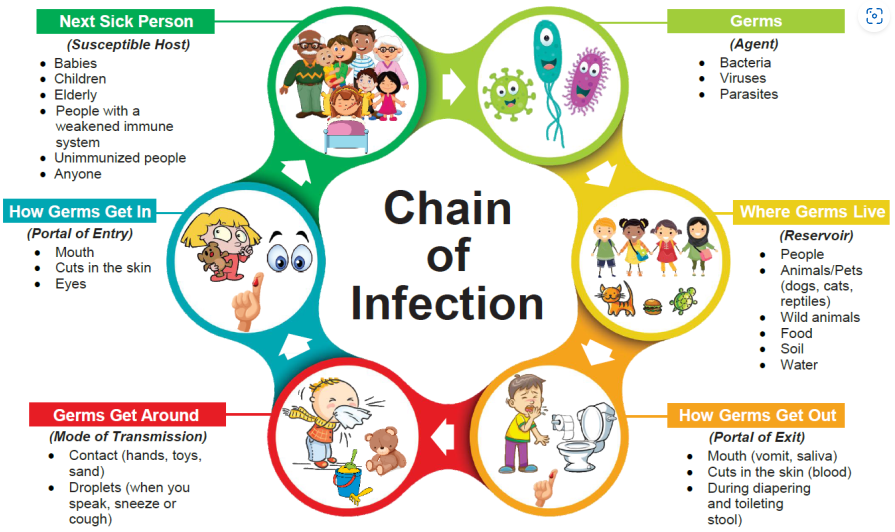
Shared items and high touch surfaces can be sources for spread of infection, especially in child care settings and schools. Such surfaces may include door knobs, taps, handrails, phones, computer keyboards, elevator buttons, countertops, as well as shared sports equipment or toys. These surfaces and items can easily become contaminated by viruses or bacteria which can spread from one person to another. Developing policies and procedures for cleaning and disinfection is important to prevent the spread of infections in your setting or school.
Cleaning
Cleaning is the physical action of removing debris from a surface. Cleaning with soap or detergent, and water, will remove organic material such as food, body fluids, fecal matter, or soil from surfaces. Residue from the soap or detergent must be rinsed off prior to disinfection to prevent neutralization of some disinfectants.
Disinfection
Disinfection must occur after cleaning. Disinfection inactivates or kills microorganisms (germs) that may be present on surfaces and that cleaning does not remove.
All-in-one cleaning/disinfecting products must contain a drug identification number (DIN) from Health Canada. The disinfectant contact time, which is the time that a surface must remain wet for a disinfectant to be effective, varies between products. Follow manufacturers' instructions for disinfectant contact times, dilution and handling of products, including for pre-saturated disinfectant wipes.
Flip-top bottles are preferred to apply cleaning solution. If using a spray bottle, saturate the cloth first then wipe the surface. Avoid the use of aerosol cans as this can propel the germs and cleaning solution into the air.
Household bleach diluted in water is an inexpensive and effective disinfectant and can be used for most surfaces. It should be prepared daily. Ensure that surfaces are cleaned with a detergent or cleaning agent before the household bleach mixture is used as a disinfectant.
Mixing some cleaners and disinfectants (like chlorine bleach and ammonia) can be harmful, even deadly. Others can irritate your eyes, nose, or throat and cause breathing problems.
Guide for Preparation of Bleach Solutions
The following table can be used as a reference for preparing household bleach solutions:
|
Disinfectant
solution
|
Contact time |
When to use |
Advantages |
Disadvantages |
|
1:499 chlorine bleach*
(1 part bleach to 499
parts water); 100 ppm
|
1 minute |
Sanitize food contact surfaces such as, high-chair trays and communal dining tables |
Inexpensive, fast-acting |
- Always requires cleaning prior to disinfection (cannot be used as a 1- step cleaner/disinfectant).
- Corrosive to metal.
- Inactivated by organic material and light.
- May irritate skin, eyes, throat or lungs.
- Must be prepared/used in a well-ventilated area.
- Limited effectiveness during outbreaks (ineffective against norovirus).
|
|
1:250 chlorine
bleach* (1 part bleach to 249 parts water); 200 ppm
|
1 minute |
Routine disinfection, no rinsing required. Use on low-touch surfaces |
|
1:100 chlorine
bleach* (1 part bleach to 99 parts water); 500 ppm
|
1 minute |
Routine disinfection of high-touch surfaces such as diaper change tables.
Rinsing required for mouthed toys or food contact surfaces
|
|
1000 ppm chlorine
bleach (20 mL bleach + 980 mL water)
|
Minimum 2 minutes; allow to air dry |
Use during an outbreak in childcare settings |
More effective concentration for outbreak control |
- Stronger irritant
- May damage surfaces/materials
- Requires ventilation and PPE
|
|
5000 ppm chlorine
bleach (100 mL bleach + 900 mL water)
|
Minimum 2 minutes; allow to air dry |
Use on surfaces/items contaminated with blood or body fluids |
Very strong, effective for bloodborne pathogens |
- Corrosive
- May damage surfaces/materials.
- Irritant to skin, eyes and lungs.
- Requires careful handling.
|
| 200 ppm Quaternary ammonium compound |
10 minutes; follow MIFUs** |
Floors and low-touch surfaces; can also sanitize food contact surfaces such as high-chair trays and communal dining tables. |
Can be used as a sanitizer on food contact surfaces |
- Limited effectiveness during outbreaks (ineffective against norovirus).
|
| Accelerated hydrogen peroxide (0.5%) |
Follow MIFUs** |
Routine disinfection of most objects and surfaces; may be used during gastroenteritis outbreaks. |
Inexpensive, fast-acting, non-toxic, short contact times; effective against norovirus |
- May damage some surfaces/materials such as copper or brass.
- Pre-cleaning may be required.
- May require rinsing after use (if used on mouthed toys or food contact surfaces)
|
*Based on household bleach solution of 5.25% sodium hypochlorite solution (50 000 parts per million)
**Product manufacturer’s instructions for use (MIFU)
The above table is also available for download: Disinfectant Reference Table for Child Care Centers (PDF – 300 KB)
Cleaning and disinfection schedule
Commonly touched surfaces and items should be cleaned and disinfected frequently (e.g. at least once a day) to limit the potential spread of germs. When the setting is experiencing an outbreak, cleaning and disinfection of these surfaces and items is required more often. This easy-to-use guide outlines the recommended frequencies and key considerations for cleaning and disinfection practices within your facility. This schedule supports child care centers with adhering to best practices, minimizing the risk of infection.
Cleaning and Disinfection of Toys
Infants and young children share toys and often place them in their mouths. This increases the risk of spreading infections. To reduce this risk, play areas and storage spaces should be cleaned and disinfected on a regular basis. Ensure that the disinfectant is safe and suitable for use on toys. Consult the manufacturer's recommendations for dilution and contact times for these disinfectants.
Cleaning and disinfecting hard plastic toys
- Remove toys from the play area after use and place them in a collection box for cleaning and disinfection
- Clean and disinfect the collection box at the same time that toys are being cleaned and disinfected
- Clean toys in hot soapy water prior to using a disinfectant
- Use a brush to clean crevices or hard to reach areas
- Rinse toys well under running water as soap may neutralize the disinfectant
- Soak toys in an appropriate disinfectant for required amount of time (contact time)
- Rinse toys with clean water to remove any disinfectant solution, if indicated on the label; bleach does not require rinsing
- Clean and disinfect dishwasher-safe, hard plastic toys in a commercial dishwasher with a sanitizer or a hot rinse cycle
- Completely air dry toys before they are returned to use
- Keep a record of when toys were cleaned and disinfected
Cleaning and disinfecting soft, porous toys or dress up clothes
- Launder fabrics or plush toys in a washing machine with hot water, and dry in a clothes dryer on a hot cycle
- Avoid using disinfectant products on porous surfaces
Cleaning other items
- Clean and disinfect other items (e.g., scissors, puzzles, storage bins, etc.) when they are visibly dirty
- Items such as books and some craft equipment may be difficult to clean, so consider discarding them once they are soiled
- Avoid sensory play during an outbreak, such as activities using play dough, sand or water
- Clean and disinfect computer keyboards, mice and other electronics between uses
Diaper changing
Diapering areas in child care settings are important to consider in preventing the spread of germs.
The following measures are important infection prevention and control practices for such areas:
- Keep the diapering stations separate from food preparation, eating and activity areas
- Ensure the surface for diapering is made of a smooth, non-porous and cleanable material
- Dedicate a hand wash sink close to the diapering station with warm water, soap and disposable towels
- When diapering a child, it is important to ensure that staff wash their hands prior to putting on gloves and handling the soiled diaper
- Gloves should be removed after handling the soiled diaper, followed by hand washing
- Gloves are single use and should not be used for another task or for diapering another child
- Place soiled diapers immediately in a nearby garbage can with a secure lid and disposable liner; a foot operated garbage can is preferred
- Used cloth diapers (outer covering and liner) must be handled as little as possible to limit and prevent exposure to body fluids. Do not shake, scrape, or rinse the cloth diapers. However, formed stool may be released into a toilet if it can be done so with ease, then place soiled items into a plastic bag and return to parents. During an outbreak, children using cloth diapers should switch to disposable diapers for the duration of the outbreak
- Ensure personal diapering items are clearly labelled for each child (creams, wipes and diapers); do not use a child's dedicated items on another child
- If a child's clothing becomes soiled, place it in a plastic bag and send home for laundering
- Use an appropriate cleaner and disinfectant to clean the diapering surface between each use (e.g., after each diaper change)
- Assist children with hand washing after diapering
Potty chairs