
- Number of days of the special event.
- Amount of hazardous foods.
- Number of food preparation steps.
- Food handler training.
Food Vendors at Special Events
The following requirements have been established to reduce the risk of food-borne illness. Please complete and submit the Application Form for Food Service at a Special Event, to Ottawa Public Health at least two weeks prior to the event. Once the completed application form has been received it will be reviewed by a public health inspector (PHI). If required, a PHI may contact you to discuss safe food practices specific to your temporary food premises.
General information
- During the application process, you will be asked to list the foods you will be serving at the special event. Ensure that all food is obtained from an approved source. You could be required to submit receipts to prove this.
- Food being sold or served at a special event must be prepared in an approved kitchen.
- Food preparation at the event site is limited to re-heating, hot/cold holding, final assembly, and serving the product unless discussed with Ottawa Public Health prior to the event.
You will be asked about details on transporting the food at the event.
Important considerations:
- Hazardous food must be transported, stored, and maintained at proper temperature.
- Cold foods must be kept at 4°C (40°F) or lower and hot foods must be kept at 60°C (140°F) or higher.
- Transport food in clean insulated containers.
- Containers must be used for food only. Food and containers must be stored away from chemicals.
- For cold foods use ice packs in insulated containers and place in the coolest part of the vehicle.
- Frozen foods must be transported in freezers or in a manner that can maintain the food at -18°C (0°F).
- All food and equipment must be protected from contamination.
Food preparation at special events
Food served at an outdoor event, must be prepared and served from a structure (mobile vendor or a canopied area). The food assembly and serving area must be clean at all times. An overhead cover is necessary to protect the food.
Re-heating and hot holding: All hazardous food must be purchased pre-cooked or are pre-cooked in a kitchen that is approved and inspected by a public health inspector. Probe thermometers are required to check the internal temperature of hot hazardous food. This ensures the food has been thoroughly cooked (prior to the event) and reheated (at the event). Refer to the Cooking and Re-heating Temperatures.
Once food is re-heated it can be hot held. Hot holding equipment must be capable of maintaining the food at a minimum internal temperature of 60°C (140°F). Steam tables and barbecues are good examples. Use a probe thermometer to check the internal temperature of hot hazardous food. Ensure it is cleaned and sanitized between each use.
Cooking and Re-heating Temperatures
|
Hazardous Food Items |
Cooking °C (°F) for 15 seconds |
Reheating °C (°F) for 15 seconds |
|---|---|---|
|
Whole poultry |
82°C / 180°F |
74°C / 165°F |
|
Poultry / Ground poultry |
74°C / 165°F |
74°C / 165°F |
|
Pork / Pork products |
71°C / 160°F |
71°C / 160°F |
|
Ground meat (beef, pork) |
71°C / 160°F |
71°C / 160°F |
|
Fish |
70°C / 158°F |
70°C / 158°F |
|
Hazardous food mixtures |
74°C / 165°F |
74°C / 165°F |
Cold storage must be capable of maintaining 4°C (40°F) at all times. Storage thermometers are required.
Only single-service eating utensils, such as plastic forks, spoons, knives, cups, and paper plates, can be used. Purchase them pre-wrapped and store them in clean container off the ground.
A sufficient number of wrapped, clean, back-up utensils must be available if the original utensils become contaminated.
Every temporary food premises that handles an open food product must be equipped with their own separate hand wash basin. The hand wash basin must be located in a convenient location within the temporary food premises.
- Washroom sinks cannot be used for this purpose.
- Hand sanitizers do not replace the requirements for a separate hand wash basin. Hand sanitizer should only be used by non-food handlers such as a cashier.
- Disposable gloves do not replace the requirements for a separate hand wash basin.
Serviced sites (hydro and a water connection is available to all vendors)
The hand wash basin must be equipped with potable hot and cold running water under pressure, a supply of liquid soap and paper towels in a dispenser.
Unserviced sites (hydro and a water connection is not available to all vendors)
For events lasting one day or less:
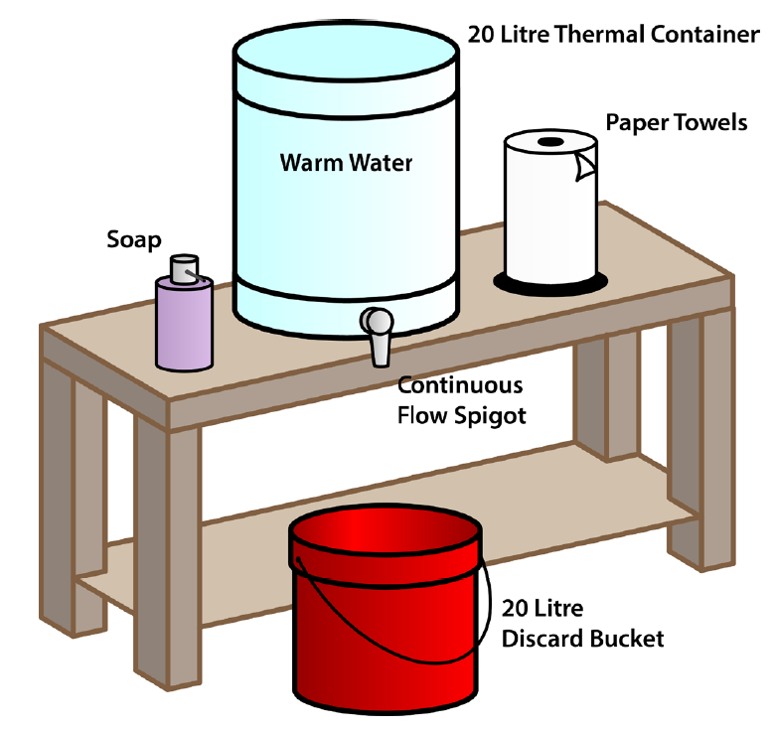
- A temporary hand wash basin will be permitted (see temporary hand wash station picture below).
For events lasting two or more days:
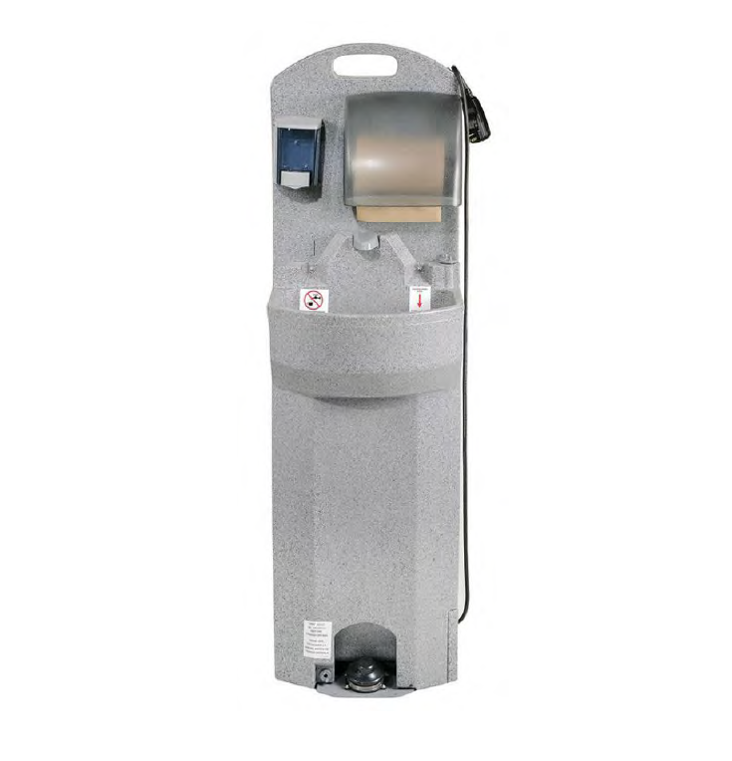
- A more structured hand wash basin is required (see structured hand wash station picture below). For example, a foot pump operated hand wash basin equipped with running water, a supply of liquid soap and paper towel in a dispenser.
Temporary hand wash station
Structured hand wash station
Protection against contamination
- All food must be protected against contamination from dust, insects, and other sources by using, for example, lids, plastic wrap or aluminum foil.
- Condiments must be offered in individual packages or dispensed from containers that protect the condiments from contamination (for example, squeeze bottle, pump).
- Containers of food and food service items must be stored at least 15 cm (6 inches) above the ground.
- All food handlers must wear clean outer clothing and confine their hair by wearing hairnets or hats.
- Smoking is not allowed while working in the temporary/mobile food establishment.
- Perform hand washing as often as is necessary.
- Do not work if you are ill.
- Minimize direct food handling by using tongs or utensils.
Serviced sites (hydro and a water connection are available to all vendors)
- A two-compartment sink must be provided and equipped with potable hot and cold running water.
- Utensils and equipment must be washed, rinsed and sanitized using the two compartment sink method.
Unserviced sites (hydro and a water connection are not available to all vendors)
- Based on a risk assessment a two compartment sink may be required.
- Low-risk vendors must be equipped with a sufficient number of extra utensils. The extra utensils will serve as back-up should utensils become contaminated. Four sets of clean utensils are recommended for each day of the event. The extra utensils must be clean, and wrapped to prevent contamination during storage.
- Utensils that are not washed on-site must be washed/rinsed/sanitized in a commercial premises.
Two-compartment sink method
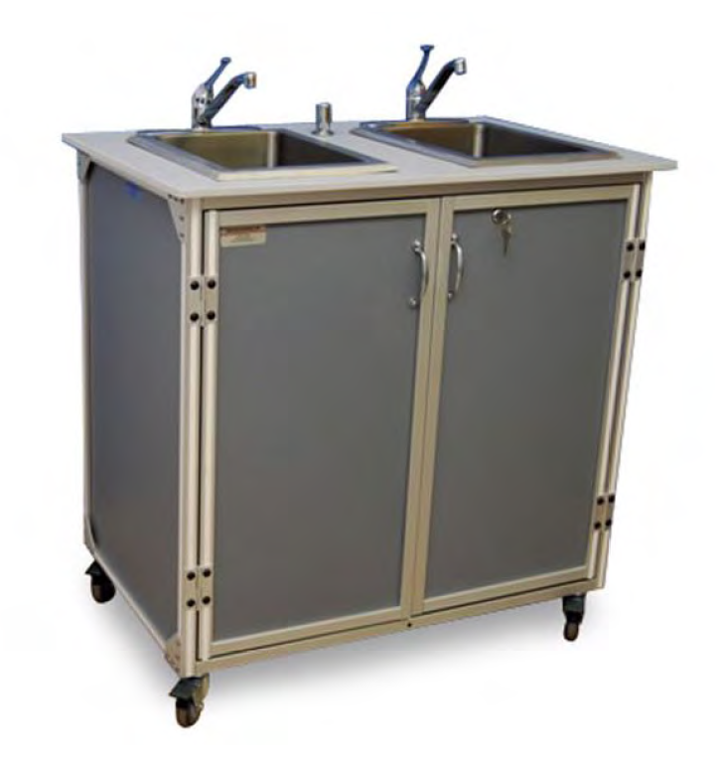
Follow the steps below to properly wash dishes:
- Scrape dishes
- Wash dishes in the first sink with a clean, warm, solution of detergent and water, then rinse dishes with clean water. In the second sink, sanitize dishes in a chemical solution by filling the sink with clean, warm water, and adding enough bleach to make a 100ppm solution. Refer to "Approved sanitizers for use at your special event" for more information. If you are using quaternary ammonia instead of bleach, add enough to make a 200ppm solution. Submerge dishes for 45 seconds.
- Allow dishes to air dry.
Garbage and liquid waste must be disposed of in a sanitary manner. Liquid waste must not be disposed on the ground.
Cleaning and sanitizing food contact surfaces
Sanitizing solutions must be on hand in a bucket or in a labeled spray bottle mixed to the proper strengths to ensure food contact surfaces are clean and sanitary throughout your event. Food contact surfaces must be cleaned with soap and water prior to sanitizing. For acceptable sanitizer products and proper sanitizer strengths see below.
Cleaning and sanitizing probe thermometers
Probe thermometers must be cleaned with soap and water and then sanitized using alcohol swabs or a double-strength sanitizing solution as described below. Cleaning and sanitizing probe thermometers between each use ensures that there is no cross-contamination.
Approved sanitizers for your special events
Chlorine based products 100ppm
The most common chlorine-based product is household bleach mixed with water. To make a 100ppm concentration, mix ½ teaspoon of (5 per cent strength) bleach per litre of water.
To sanitize food contact surfaces using bleach mixed with water, a double-strength (200ppm) concentration is required. To make a 200ppm concentration, mix ¾ teaspoon of (5 per cent strength) bleach per litre of water.
Quaternary ammonia based products 200ppm
Quaternary ammonium-based cleaning compounds are also referred to as "quats". To make a 200ppm "quat" concentration, measure according to the manufacturer's label. You may need to rinse any food contact surface after sanitizing with ammonium using clean water. Follow the manufacturer's label instructions regarding this.
Soft surfaces (grass, sand and mud) require flooring.
Approved flooring:
- Plywood
- Rubber mats
- Pavement
Unapproved flooring:
- Tarps
- Plastic
- Carpeting
You are required to ensure that there is at least one food handler or supervisor onsite who has completed food handler training during every hour in which the event is operating. For more information, visit the Certified food handler training page.