
Ottawa Public Health - Signage - Outbreak alert (PDF 105 KB)
Long Term Care Facilities and Retirement Homes
Reporting and requests
To report an outbreak during regular business hours, please complete the Notification of Increase in Illness Intake Form below or call 613-580-2424 extension 26325. Evenings, weekends or holidays, call 3-1-1 and ask to speak with the Public Health Inspector on-call.
To report a line list for an ongoing outbreak, use the Ongoing Outbreak Line List Reporting Form below.
Outbreak Line List
Please use the templates below in either print format or PDF fillable format for reporting of cases to the Infection Prevention and Control team at Ottawa Public Health.
Fillable version - Outbreak line listing (pdf - 1 MB) Print version - Outbreak line listing (pdf - 1 MB)
Signage, posters and fact sheets
- Ottawa's Health is in Your Hands Poster
- Hand washing poster - English [pdf - 930 KB]
- Hand washing poster and factsheet - English [ pdf - 606 KB]
- Hand sanitizing poster - English and French [pdf - 5.4 MB]
- Cough etiquette poster - English [pdf - 3 MB]
For signage in additional languages, please refer to Ottawa Public Health’s Hand Hygiene webpage.
Personal protective equipment (PPE)
- Public Health Ontario: Poster - Recommended steps for putting on and taking off PPE
- Public Health Ontario: Video - Putting on Full Personal Protective Equipment
- Public Health Ontario: Poster - Donning PPE
- Public Health Ontario: Poster - Doffing PPE Poster
- Ottawa Public Health: Poster - Masks continue to be recommended in crowded spaces (pdf - 107 KB)
- Ottawa Public Health: Poster - Safely putting on and taking off your mask (pdf - 7 MB)
- Ottawa Public Health: Video - How to properly wear a mask video
- Ottawa Public Health: Poster - COVID-19 Eye Protection Guideline (pdf - 139 KB)
Additional precautions signage and lanyard cards
Public Health Ontario has developed standardized infection prevention and control signage and lanyard cards for hospitals and long-term care homes to assist with the implementation of Routine Practices and Additional Precautions and provide consistent visual messages about recommended additional precautions and PPE.
Visit the Public Health Ontario website to download the following signs:
For additional information please visit our Mould webpage.
For additional information please visit our Bed Bug webpage.
Resources and guidance
For the COVID-19 outbreak definition, please consult the Ministry of Health’s; Infectious Disease Protocol Appendix 1: Case Definitions and Disease-Specific Information Disease; Coronavirus Disease 2019 (COVID-19).
For the Respiratory unspecified outbreak definition, please consult the Ministry of Health’s; Infectious Disease Protocol Appendix 1: Case Definitions and Disease-Specific Information Disease; Respiratory Infection Outbreaks in Institutions and Public Hospitals.
For the Gastroenteritis outbreak definition, please consult the Ministry of Health’s; Infectious Disease Protocol Appendix 1: Case Definitions and Disease-Specific Information Disease; Gastroenteritis, Outbreaks in institutions and public hospitals.
Screening residents and staff regularly for early signs and symptoms of illness may help to detect and prevent the spread of disease and may reduce the risk of outbreaks.
Ottawa Public Health recommends that staff continue to self-monitor prior to entering the Long-Term care home, retirement home or congregate living setting. A self-assessment tool is available on the Ontario Health website.
Testing and isolation are highly recommended for all individuals experiencing symptoms who reside or work in a high-risk setting*.
As per the latest Ministry of Health Guidance, Ottawa Public Health (OPH) would like to call attention to the recommendations regarding transfers and repatriations to Long Term Care Homes (LTCHs), Retirement Homes (RH) and congregate living settings. Residents are no longer required to be tested prior to or upon repatriation to their home if they do not present with symptoms. It is however, recommended that facilities screen the resident upon entry and act accordingly.
For COVID-19 specific guidance on testing and isolation, please refer to the MOHs’ Infectious Disease Protocol Appendix 1: Case Definitions and Disease-Specific Information Disease; Coronavirus Disease 2019 (COVID-19). and the MOH’s Recommendations for Outbreak Prevention and Control in Institutions and Congregate Living Settings or OPH’s COVID-19 Testing and Care Information page.
*High risk settings include acute care settings such as hospitals, including complex continuing care facilities; congregate living settings, including, Long-Term Care, retirement homes, First Nation elder care lodges, group homes, shelters, hospices, correctional institutions, and hospital schools.
Please refer to OPH's Outbreak Control Measures for Institutions, Congregate Living Settings, Child Care Centres and Schools for guidance of control measures based on your setting.
When an outbreak is suspected or declared, it is recommended t/hat facilities increase their environmental cleaning and disinfection of all high-touch surfaces and resident rooms to twice daily (minimum).
Is it important to ensure that the product is effective against the agent circulating in the home. Accelerated hydrogen peroxide products will often cover a large spectrum of pathogens frequently identified in healthcare institutions.
Products with shorter contact times (1 minute, 3 minutes) are preferred to ensure the surface has been cleaned and disinfected appropriately. Please ensure to review the contact time of your products to ensure proper environmental cleaning protocols.
Access the Public Health Ontario website for additional resources on environmental cleaning and disinfection best practices.
How to dispose of expired alcohol based handrub (ABHR)
- Do not pour expired ABHR down the sink or toilet as this can contaminate water systems and violates environmental regulations.
- Do not place expired ABHR in regular garbage.
- Contact a licensed hazardous waste disposal company for pickup and proper disposal.
- The City’s household hazardous waste events are for household hazardous waste only and commercial, industrial or institutional waste will not be accepted.
Specimen identification is a critical part of outbreak investigations. Once the causative agent is known through specimen testing, the public health unit and the home can determine the appropriate next steps to mitigate transmission by implementing targeting interventions.
Specimen collection kits can be ordered through Ottawa Public Health using the Facility Stool Specimen Collection Request Form when an outbreak has been declared. For all other testing purposes, please contact your laboratory services company to obtain the required specimen kits.
Stool specimen kit
The kit
The kit contains two sterile containers, a biohazard bag and requisition sheet. Please refer to the table below for details.
Kit contains two sterile containers:
| Container Number | Colour of Cap | Transport Media | Test Required |
|---|---|---|---|
| #1 | White cap | Empty vial | Virology |
| #2 | Green cap | Red transport medium | Bacteriology |
The requisition
Please ensure that all the sections (1, 2, 4 and 5) of the requisition are completed. Any incomplete requestions will result in their rejection at the laboratory.
Take special care to ensure that the following sections and fields are filled out:
- Patient information section
- Public health unit outbreak number
- Date stool sample collected
- Date of symptom onset
The collection
Before collecting:
- Verify the expiration dates on the sterile containers. Do not use expired kits, they will be rejected by the testing laboratory.
- If blood or mucous is found in the stool, take the sample from this part of the stool.
- Stool specimens that have been in contact with water in the toilet are unable to be accepted due to contamination.
When collecting:
*These first two steps are very important – if the label and/or form are missing information, illegible, or filled out incorrectly, the lab will not test the sample.
1. Fill out the label
- Label the sample containers with the individual’s name, date of birth, health card number (if known), and the date and time the stool sample was collected.
2. Complete the requisition
- Complete all of the required sections of the requisition (see the section on requisitions above).
3. Collect the stool sample
- Individuals who are independent: Defecate into a clean container (i.e., disposable plate, adult incontinence product, collector container).
- Individuals who require assistance/are incontinent: Collect the stool sample from the soiled adult incontinence product.
- Using the individual “scoop” attached to each of the caps, transfer the stool into the corresponding sterile containers. Fill the white cap container first.
- Fill to the line indicated on the container. Do not over fill.
- Tighten the caps. Do not use excessive force to tighten the caps as the containers may crack and leak. Samples that have leaked in transit will be rejected.
- Place the containers in the inner pocket of the plastic biohazard bag and seal it.
- Place the general test requisition form in the small outer pocket of the plastic biohazard bag. DO NOT place the form in the inner pocket.
- Place the biohazard bag into the brown paper bag and refrigerate the sample(s) immediately after collection. Stool samples should be placed on the bottom shelf of a fridge and food should not be stored in the same fridge as the stool samples. A cooler with ice or an ice pack can be used if a separate fridge is not available. Do not freeze the samples.
- Perform hand hygiene. If hands are visibly soiled, use soap and water.
- Complete the Facility Stool Specimen Collection Request Form or call Ottawa Public Health at 613-580-2424 x 26325 for stool sample pick-up and delivery to the Public Health Laboratory located in Ottawa. Deadline for same day pick-up is 3:00 pm. Do not send with your regular lab courier.
Packaging and transportation
When packaging specimen containers for delivery:- Ensure to include the completed specimen requisition forms for each specimen.
- Package the specimen to prevent leaking and use ice packs to maintain temperature.
- Clean and disinfectant cooler bag with a hospital grade disinfectant before and after delivery.
Influenza, vaccines and antivirals
Influenza, vaccines and antivirals
Influenza
For information related to influenza symptoms, transmission, and prevention, refer to the OPH Influenza webpage.
Vaccines
Long-term care home (LTCH) and retirement home (RH) sectors are critical stakeholders in the response to influenza. Residents of these institutions are particularly vulnerable to severe illness and death from influenza. Efforts to keep influenza out of these institutions such as early detection of cases and vaccinations are vital to infection prevention and control.
To order your flu vaccines for this year’s season, please complete the Influenza Vaccine Order Form or follow the instructions on the memo that will be distributed by the OPH Immunization team.
The influenza vaccine consent forms must be completed for each resident including those who have a power of attorney (POA). The consent forms will also be shared via memo by the OPH Immunization team.
Antivirals
There are currently two antiviral drugs that are licensed in Canada for the treatment and prophylaxis of influenza A and B, including oseltamivir (Tamiflu) and zanamivir (Ralenza). When using antivirals for the treatment of influenza, it is important that they are initiated as soon as possible within 48 hours of symptom onset.
OPH recommends oseltamivir as the drug of choice for both the treatment and prophylaxis of residents in long-term care homes (LTCHs) for the following reasons:
- The use of Zanamivir has not been proven effective for prophylaxis of influenza in the LTCH setting
- Elderly individuals may have difficulty inhaling zanamivir
- Zanamivir is not recommended for treatment or prophylaxis of influenza in individuals with underlying respiratory conditions such as chronic obstructive pulmonary disease (COPD) or asthma due to the risk of bronchospasms
- Reimbursement for zanamivir for residents occurs only when the predominant strain is resistant to oseltamivir
Flumist is a vaccine option in Ontario that is only publicly funded for children from 2 to 17 years of age. If a staff member or resident chooses to be immunized with Flumist privately, it is recommended that LAIV (Flumist) not be administered until 48 hours after antiviral treatment or prophylaxis for influenza is stopped.
Management of staff during an influenza outbreak
It is important for staff to be advised upon hire about the influenza policy of the facility and/or their collective agreement, and the options available to them in the event of an influenza outbreak if they are not immunized.
When an influenza outbreak occurs, staff must obtain prescriptions for antiviral medication from their own health care provider and are responsible for their own antiviral-related expenses, unless they have coverage through a company or private health insurance plan. They are not eligible for prescription drug coverage under any circumstances from the Ontario Drug Program (ODP). Only under very specific circumstances, immunized health care workers may be eligible for reimbursement through the High Intensity Needs Fund (HINF).
During a laboratory-confirmed influenza outbreak, when the circulating strain is not well-matched by the vaccine, antiviral prophylaxis should be offered to all staff, regardless of vaccination status, until the outbreak is declared over, based on consultation with OPH.
Immunized staff
| Period between immunization and outbreak declaration | Immunized (inactivated vaccine) | Immunized (live attenuated vaccine - i.e. Flumist) |
|---|---|---|
| More than 2 weeks |
|
|
| Less than 2 weeks |
|
|
Unimmunized Staff
- Unimmunized staff should be offered vaccine and take antiviral prophylaxis until immunity is reached or until the outbreak is declared over, whichever is shorter.
- Unimmunized staff who refuse to be immunized must take antiviral prophylaxis until the outbreak is declared over; staff may work with residents as soon as they start antiviral prophylaxis.
- Staff accepting to be immunized, but refusing antiviral medication, should NOT be permitted to work in the outbreak-affected area for a two-week period. Prior to being reassigned to another unit, they must be asymptomatic for 72 hours (3 days).
Management of residents during an Influenza outbreak
Prophylaxis
- During a laboratory-confirmed influenza outbreak, antiviral prophylaxis should be offered to all residents in the outbreak-affected area who are NOT already ill with influenza, regardless of immunization status, until the outbreak is declared over
- If respiratory symptoms develop in a resident while on prophylaxis, the dose should be switched to a treatment dose for five days. After five days, if influenza is not lab confirmed, the resident should return to the prophylactic dose until the end of the outbreak.
Treatment
Once an outbreak has been laboratory-confirmed as influenza, additional laboratory confirmation of new cases is not required to begin treatment of residents who meet case definition. It is important that:
- Antiviral treatment of ill residents who meet case definition is started as soon as possible, and within 48 hours of symptom onset.
- Ill residents remain in their rooms for the duration of the antiviral treatment, which should be a total of five days. It is important to note that if a symptomatic resident has already initiated isolation based on symptoms prior to the commencement of antiviral treatment (i.e., awaiting laboratory results), the five-day isolation period begins on the first day of isolation, not upon the initiation of antiviral therapy.
Circumstances that may affect decisions regarding use of antiviral medication
- If the resident meets case definition and has been symptomatic for MORE than 48 hours and antiviral treatment has NOT been started, use Appendix A for making decisions about the use of antivirals.
- If the outbreak is ongoing when the five-day treatment course ends AND the resident did NOT have lab-confirmed influenza (either the resident was never tested or had a negative influenza lab result) but was symptomatic, the resident should be switched to a prophylactic dose until the outbreak is declared over. This is recommended in case of a potential outbreak caused by more than one agent (see Appendix B).
When antiviral medications do not control the outbreak
If new cases continue to appear 72 to 96 hours after the start of antivirals, consider the following:
- The new cases could be caused by another organism.
- There could be compliance/adherence issues.
- Resistance to the antiviral medications may have developed in the circulating strain.
In the event that the outbreak is not controlled with antiviral use:
- Consult with the OPH Outbreak Management team to determine if the antiviral agents should be continued.
Recommended dosage for prophylaxis and treatment of influenza with Tamiflu for adults
Recommended dosage for prophylaxis and treatment of influenza with Tamiflu for adults
|
Kidney function/Creatinine clearance |
Prophylaxis is given until the outbreak is declared over |
Treatment for five days |
|---|---|---|
|
With no known renal disease OR With renal disease and creatinine clearance >60mL/min |
75 mg once daily |
75 mg twice daily |
|
With known renal disease and creatinine clearance of >30-60mL/min |
75 mg on alternate days OR 30 mg once daily |
75 mg once daily OR 30 mg suspension twice daily OR 30 mg capsule twice daily |
|
With known renal disease and creatinine clearance of 10- 30 mL/min |
30 mg every other day |
30 mg orally once daily |
|
Residents with renal failure (<10 mL/min) |
No data |
Single dose of 75 mg for the duration of the illness |
|
Dialysis residents: Low-Flux HD |
30 mg orally after every alternate hemodialysis session (initial dose can be started between sessions) |
30 mg orally after every hemodialysis session (initial dose can be started between sessions) |
|
Dialysis residents: High -Flux HD |
No data |
75 mg after each dialysis session |
|
Dialysis residents: CAPD dialysis |
30 mg orally once weekly Administered prior to the start of dialysis |
A single dose of 30 mg orally administered prior to the start of dialysis |
|
Dialysis residents: CRRT high-flux dialysis |
No data |
30 mg daily or 75 mg every second day |
Diagram 1: Influenza outbreak antiviral treatment recommendations if treatment is not initiated within 48 hours of symptom onset
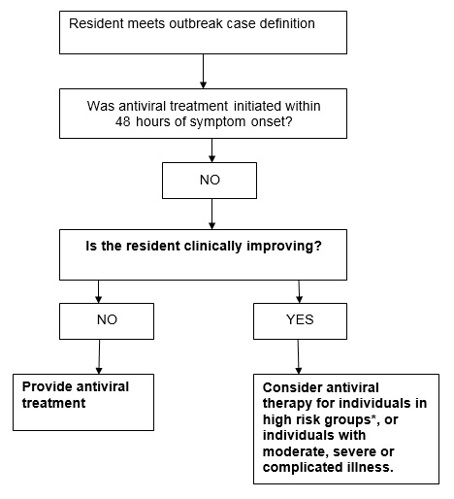
- Resident meets outbreak case definition
- Was antiviral treatment initiated within 48 hours of symptom onset? (NO)
- Is the resident clinically improving?
- NO
Provide antiviral treatment - YES
Consider antiviral therapy for individuals in high risk groups*, or individuals with moderate, severe or complicated illness
- NO
* Note: please see AMMI Influenza guidelines (as current) for a definition of high-risk groups
Diagram 2: Influenza outbreak antiviral prophylaxis recommendations for Line-listed cases after completion of treatment with antiviral medication
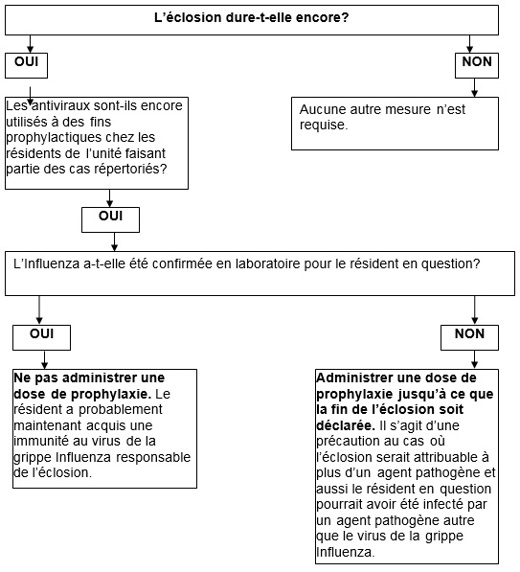
Is the outbreak still ongoing?
- NO
No further action required - YES
-
Are antivirals still being used for prophylaxis in residents on the line-listed residents' unit?
- YES
- Did the line-listed resident have laboratory confirmed influenza?
- YES
Do not provide prophylaxis. The resident would now have immunity to the influenza virus that is causing the outbreak. - NO
Start on a prophylaxis dose until the outbreak is declared over. This is a precaution in case there is an outbreak with more than one pathogen and the line-listed resident may have previously been infected with a non-influenza pathogen.
- YES
- Did the line-listed resident have laboratory confirmed influenza?
- YES
-
- Hoffman-La Roche Limited, Tamiflu Product Monograph, Sep 2022
- AMMI Canada Guideline, Use of antiviral drugs for seasonal influenza: Foundation document for practitioners – Update 2019
- AMMI Canada Guidelines, Guidance for Practitioners on the Use of Antiviral Drugs to Control Influenza Outbreaks in Long-Term Care Facilities in Canada, 2014-2015 Season, 2015
- Canadian Immunization Guide, Canadian Immunization Guide Chapter on Influenza and Statement on Seasonal Influenza Vaccine for 2019-2020
- Recommendations for Outbreak Prevention and Control in Institutions and Congregate Living Settings, 2025 (page 95-102)
Activities in Long-Term Care Homes and Retirement Homes during an outbreak
It is important for Long-Term Care Homes and Retirement Homes to assess and modify activities during the course of enteric and respiratory outbreaks to reduce the risk of transmission of infection amongst the residents and staff. Each outbreak is unique and the Ottawa Public Health investigator assigned to the outbreak will assist you with outbreak management and activity assessment.
Do all activities have to be cancelled during an outbreak?
No, but some activities may have to be cancelled. You should review your list of planned or scheduled activities to assess whether they can continue based on the likelihood that they can cause disease transmission and, if necessary, modify activities to minimize the risks.
Consider the following when assessing if an activity can continue during an outbreak:
- Outbreak status (newly declared or close to termination)
- Type of facility
- Type of outbreak (respiratory or enteric)
- Areas affected by the outbreak (number of units/floors affected or facility-wide)
- Type of activity and likelihood of transmission through sharing of objects, air space, or touching common surfaces
- Likely source of exposure to illness. For example, food, environmental surfaces, ill staff or visitors.
- Effectiveness of outbreak control measures in place
- Type of agent(s) identified
- Number of residents and staff affected and requiring modified activities
- Health status of residents affected
Third party services do not always have to be cancelled during an outbreak. Criteria to be considered include the status of the outbreak, types of services being provided, areas of the facility affected by the outbreak (facility-wide, floors, or units), and the health status of individuals receiving the service. Third party service providers must adhere to the outbreak control measures at the affected facility if providing service to residents during an outbreak.
Who can participate in activities during an outbreak?
Well residents (those who are not exhibiting any symptoms) may participate in activities that are considered low risk for transmission of infection.
Ill residents should be placed on isolation and must not participate in group activities until they are taken off precautions and are well enough to participate.
One-on-one activities can be provided to ill residents if they are feeling well enough to participate. Any items used during the activity should remain in the ill resident’s room or be cleaned and disinfected after use or discarded. Ill residents should be encouraged to remain on their units within the home.
Well staff and volunteers can assist with activities as long as they wear appropriate personal protective equipment (PPE) and practice good hand hygiene.
Where can activities for well residents take place during an outbreak?
Activities can take place on unaffected floors and units. Only well residents can participate in these activities. Events scheduled to take place outside the facility should be rescheduled if the outbreak is facility-wide. If well residents participate in off-site activities, high-touch surfaces in the vehicles used to transport them should be cleaned and disinfected after each trip.
Activities that include items that can be easily disinfected or discarded following the interaction can take place within the resident’s room.
Activities that do not involve sharing of objects can continue for well residents, such as, but not limited to, religious gatherings, choirs, sing-a-longs, movies, crafts, group discussions, and trivia games. Factors to be addressed include seating arrangements and enhanced cleaning of areas where activities take place. Activities involving shared items that cannot be easily disinfected between residents will likely have to be modified during an outbreak. Examples of activities that may have to be modified or cancelled include: visiting entertainers, bingo, card games, baking, board games, bean bag toss, fitness classes and physiotherapy.
Food provided during an activity should be served to each resident individually. Buffet or self-service options for food are not recommended. Alcohol-based hand rub should be available for residents to use prior to and after eating. Residents should not be participating in food preparation during an outbreak.
Does the dining room have to be closed during an outbreak?
No. Eating in the dining room does not count as an activity. Some facilities may re- locate dining of ill residents to an affected floor if they have the capacity to do so. During an outbreak, hand hygiene should be performed by all residents prior to entering the dining room. Tray service is to be provided to ill residents who are isolated in their rooms.
Please contact the OPH outbreak investigator assigned to the outbreak at your facility if you have any questions at 613-580-6744 or visit OttawaPublicHealth.ca.
More resources
Long Term Care Homes & Retirement Homes Immunization Tool Kit - Ottawa Public Health
Activities in long-term care homes and retirement homes during an outbreak
It is important for Long-Term Care Homes and Retirement Homes to assess and modify activities during the course of enteric and respiratory outbreaks to reduce the risk of transmission of infection amongst the residents and staff. Each outbreak is unique and the Ottawa Public Health investigator assigned to the outbreak will assist you with outbreak management and activity assessment.
Please see Ottawa Public Health’s Activities in Long-term Care Homes and Retirement Homes during Outbreaks webpage for additional information.
Family and visitor information during an outbreak
Outbreaks of illness sometimes occur in healthcare facilities and can be a stressful time for families and staff. Outbreaks are most often caused by common viruses that produce symptoms of gastroenteritis, such as nausea, vomiting and diarrhea, or respiratory illness, such as fever, cough, and sore throat. These viruses generally spread from person to person, or by touching contaminated surfaces, objects or equipment and then touching your eyes, mouth, nose or handling food or drink. For the health and well-being of everyone, it is important to implement measures to control the spread of infection as soon as possible.
Ways you can help stop the spread of illness:
- Do not visit if you are ill
- Follow the outbreak and infection control measures recommended
- Limit your visit to your family or friend
- If you are visiting an ill family member or friend, please check with the staff prior to entering his or her room
- Wear a mask, if/when applicable
- Clean your hands often with liquid soap and running water or alcohol-based hand sanitizer
- Get immunized against influenza every year
When to wash your hands:
- When entering the facility and before leaving
- Before entering and after leaving a resident’s room
- Before eating or assisting your family member or friend with his or her meals
- After going to the washroom, coughing, or blowing your nose
Recommendations for tuberculosis (TB) screening in long-term care and retirement homes
- Recommendations for Tuberculosis (TB) Screening in Long-Term Care and Retirement Homes
- Appendix A: Active Tuberculosis (TB) Disease Screening for Residents of Long-Term Care Homes and Retirement Homes
- Appendix B: Active Tuberculosis (TB) Disease Screening for Staff and Volunteers in Long Term Care Homes and Retirement Homes
Additional guidance from partnering organizations
Please contact the OPH outbreak investigator assigned to the outbreak at your facility if you have any questions or call 613-580-6744 ext. 26325 or email ipac/pci@ottawa.ca.