
|
Indicator |
Ottawa |
Ontario-less-Ottawa |
Data Source |
|
Intention to feed breast milk |
95.7% |
93.9% |
BORN 2018 |
|
Intention to exclusively feed breast milk |
86.0% |
80.6% |
BORN 2018 |
|
Any breast milk feeding on discharge from hospital or 3 days postpartum for home births |
89.6% |
92.5% |
BORN 2018 |
|
Exclusive breast milk feeding on discharge from hospital or 3 days postpartum for home births |
59.8% |
60.5% |
BORN 2018 |
|
Any breast milk feeding at 2 weeks |
93.0% |
NA |
OPH IFSS 2016 |
|
Exclusive breast milk feeding at 2 weeks |
37.8% |
NA |
OPH IFSS 2016 |
|
Any breast milk feeding at 6 months |
70.3% |
NA |
OPH IFSS 2016 |
|
Exclusive breast milk feeding at 6 months |
8.9% |
NA |
OPH IFSS 2016 |
Early Childhood (0 to 6 years) Data
For additional information on breastfeeding and early childhood resources in Ottawa, please refer to Parenting in Ottawa's website.
Breast milk feeding
In Ottawa:
- Nearly all (96%) mothers who gave birth in 2018 intended to feed breast milk to their infant and 86% intended to exclusively feed breast milk to their infant, slightly higher than in the rest of Ontario (81%) (Table 1).
- Nine out of ten (90%) mothers who gave birth in 2018 fed breast milk on discharge from hospital or three days after giving birth with a midwife. [2]
-
There has been a decrease in the proportion of Ottawa mothers who exclusively fed breast milk to their infant at discharge from hospital or three days after giving birth with a midwife, from 66.0% in 2013 to 59.8% in 2018 (Figure 7).
-
After hospital discharge or giving birth with a midwife, there is a large drop in exclusive breast milk feeding from 61% at a few days after birth to 38% at two weeks of age, among those who gave birth in 2016. [2, 10]
-
At six months of age, seven out of ten (70%) mothers were feeding breast milk and nine percent of mothers reported exclusively feeding breast milk for six months, in 2016. [10]
Data Sources and Notes for Table 1
Ottawa Public Health. Better Outcomes Registry & Network (BORN) Ontario 2018. Extracted: September 12, 2019.
-
Missing data were excluded from the calculations.
Ottawa Public Health (OPH) Infant Feeding Surveillance System (IFSS) 2016.
- The term "breastfeeding" or "breat milk feedhing" includes providing breast milk at the breast or expressed breast milk by alternate method (i.e., bottle, cup, spoon, supplemental nursing system).
- "Exclusive breast milk feeding" is defined as giving no other food or drink - not even water - to an infant, except breast milk. It does, however, allow the infant to receive oral rehydration salts, drops and syrups (vitamins, minerals, and medicines).
-
“Any breast milk feeding” includes those exclusively feeding breast milk along with those feeding breast milk in combination with another food or drink.
- <5% of data were missing and were excluded from the calculations.
- NA=Not available
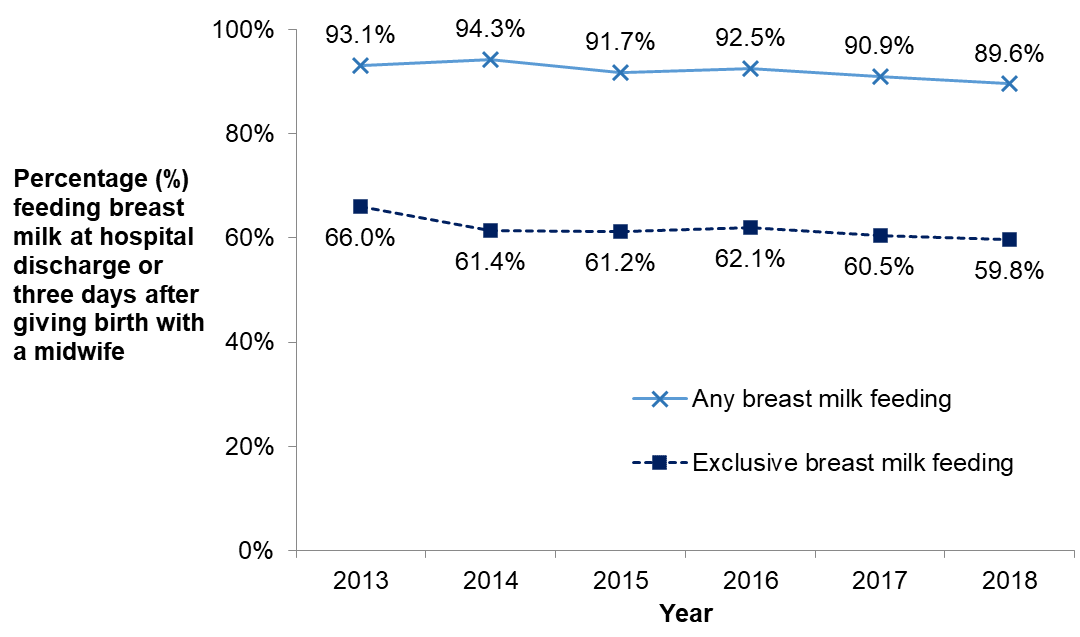
Data Sources and Notes for Figure 7
Infant Feeding at Entry to Public Health Service. Better Outcomes Registry & Network (BORN) Ontario 2013-2018. Extracted: September 12, 2019.
- Missing data were excluded from the calculations.
- The term "breastfeeding" or “breast milk feeding” includes providing breast milk at the breast or expressed breast milk by alternate method (i.e., bottle, cup, spoon, supplemental nursing system).
- "Exclusive breast milk feeding" is defined as giving no other food or drink - not even water - to an infant, except breast milk. It does, however, allow the infant to receive oral rehydration salts, drops and syrups (vitamins, minerals, and medicines).
- “Any breast milk feeding” includes those exclusively feeding breast milk along with those feeding breast milk in combination with another food or drink.
| Year | Any breast milk feeding on discharge from hospital or three days after giving birth with a midwife in Ottawa (%) |
Exclusive breast milk feeding on discharge from hospital or three days after giving birth with a midwife in Ottawa (%) |
|---|---|---|
| 2013 | 93.1% | 66.0% |
| 2014 |
94.3% |
61.4% |
| 2015 | 91.7% | 61.2% |
| 2016 | 92.5% | 62.1% |
| 2017 | 90.9% | 60.5% |
| 2018 | 89.6% | 59.8% |
Social Determinants of Health Among Families at Birth
In 2018, among Ottawa families screened at birth through the Healthy Babies Healthy Children program: [5]
- 5% reported that the mother and baby did not have a designated primary care provider;
- 4% reported that they had concerns about money to pay for basic necessities such as housing/rent, food, clothing or utilities;
- 4% needed newcomer support;
- 3% reported that the father/partner or support person was not involved in the care of the baby;
- 3% were a single parent;
- 3% had not completed high school; and
- <1% reported that at least one parent had a disability that could impact their parenting.
18-month Well-Baby Visits
The 18-month enhanced well-baby visit provides healthcare providers an opportunity to determine whether a child is meeting important developmental milestones such as motor, speech and language skills, social and emotional development, to review immunizations, healthy eating, dental care, hearing and vision, and to refer to specialized services for early intervention, as needed.
- In Ottawa, two thirds (66.8%) of children aged 17 to 24 months had a well-baby visit with a healthcare provider in 2022 and this was similar to the provincial average (67.7%). [11]
Early Child Development
From birth to six years there exist critical periods during which particular physical, emotional, social, language and communication skills are developed. The Early Development Instrument (EDI) is a population-based measures of children’s developmental health across five domains, which in turn are divided into 16 sub-domains. Six EDI cycles have been completed in Ottawa, starting in 2005/06.
Please refer to the EDI page of the Mental Health, Addictions and Substance Use Health Community Dashboard for up-to-date data on the EDI and trends over time in Ottawa. The data are nested under the "Are children and their families safe and well?" sub-domain of the "Do people live with opportunity and equality?" domain.
In Ottawa:
- In 2022/23, 28.0% of senior kindergarten (SK) children were vulnerable in at least one of five EDI domains. This percent has increased over time, is now the same as the provincial baseline established in 2004/06 (28.0%), and below the 2022/23 provincial results (31.1%). [13]
- In 2022/23, the percent of SK children “not on track” in Ottawa was higher than the province in only one domain, Language and Cognitive Development (23.8% Ottawa vs. 18.7% Ontario). [13]
- Of concern, the percent of SK children vulnerable in the Emotional Maturity domains has increased over time. (Table 2).
- In 2022/23, the sub-domains where the highest percentage of Ottawa children met few or none of the developmental expectations were [13]:
- Prosocial and helping behaviour (29.8%),
- Communication skills and general knowledge (23.5%),
- Interest in literacy, numeracy, and memory (17.2%),
- Hyperactivity and inattention (14.3%),
- Advanced literacy (14%), and
- Gross and Fine Motor Skills (13%).
- In 2015/16, the percentage of children vulnerable in at least one EDI domains ranged from 7% to 48% across Ottawa neighbourhoods. The percentage of children vulnerable in at least one EDI domain generally increased with decreasing socioeconomic status. [12]
- In 2015/16, neighbourhoods with a high proportion of children vulnerable in at least one EDI domain included Sandy Hill (48%), Overbrook (46%), Carleton Heights (46%), Pinecrest/Queensway (43%), Hunt Club West (40%), Lower Town (40%), and Riverview/Hawthorne (39%). [12]
| EDI Domain (% Vulnerable) | EDI Sub-domain (% Meeting Few or None of the Developmental Expectations) |
|---|---|
| Physical Health and Well Being (11.6%) | Physical Readiness for School Day (3.5%) |
| Physical Independence (8.9%) | |
| Gross and Fine Motor Skills (13.0%) | |
| Emotional Maturity (12.6%) | Prosocial and Helping Behaviour (29.8%) |
| Anxious and Fearful Behaviour (3.7%) | |
| Aggressive Behaviour (10.8%) | |
| Hyperactivity and Inattention (14.4%) | |
| Social Competence (8.8%) | Overall Social Competence (7.5%) |
| Responsibility and Respect (5.6%) | |
| Approaches to Learning (6.3%) | |
| Readiness to Explore New Things (3.9%) | |
| Language and Cognitive Development (7.9%) | Basic Literacy (7.5%) |
| Interest in Literacy/Numeracy and Memory (17.2%) | |
| Advanced Literacy (14.0%) | |
| Basic Numeracy (7.3%) | |
| Communication Skills and General Knowledge (10.9%) | Communication and General Knowledge (23.5%) |
Data Sources and Notes for Table 2
Offord Centre for Child Studies. Summary Report on Senior Kindergarten Students in the province of Ontario, City of Ottawa 2022/2023 - A snapshot of children's developmental health at school entry. Hamilton, ON. 2024
- Categories of developmental health:
- At risk children are those who score between the 10th and 25th lowest percentile in a domain.
- Vulnerable children are those who score below the lowest 10th percentile in a domain.
- “Not on track” includes children who score below the lowest 25th percentile (at risk + vulnerable) in a domain.
References
- Public Health Ontario. Reproductive Health Snapshot (2014-2023): Fertility rates (per 1,000 females of reproductive age). https://www.publichealthontario.ca/en/Data-and-Analysis/Reproductive-and-Child-Health/Reproductive-Health Accessed August 11, 2025.
- Ottawa Public Health. Ottawa births, Better Outcomes Registry & Network (BORN) Ontario 2013-2024. Extracted August 6, 2025.
- Ottawa Public Health. Better Outcomes Registry & Network (BORN) Ontario Information System 2024. Extracted 29 July 2025.
- Ottawa Public Health. Better Outcomes Registry & Network (BORN) Ontario Information System 2018. Extracted 12 September 2019.
- Ottawa Public Health. Integrated Services for Children Information System (ISCIS) 2018. Extracted September 19, 2019.
- McCain MN, Mustard, J.F., Shanker, D.S. Early years study 2 - Putting science into action. 2007.
- Crill Russell C. Parenting in the beginning years: priorities for investment. Toronto, Canada: Invest in Kids; 2003.
- Patterson J, Mockford, C., Barlow, J., Pyper, C., Stewart-Brown, S. Need and demand for parenting programmes in general practice. Archives of Diseases in Childhood. 2002; 9:468-71.
- Ottawa Public Health. Rapid Risk Factor Surveillance System, 2016-2017.
- Ottawa Public Health. Infant Feeding Surveillance System 2016.
- Koh, M. Implementation of a physician incentive program for 18-month developmental screening in Ontario, Canada - 2024 Update. Applied Health Research Question (AHRQ) 2026 0950 118 003. Toronto: ICES; 2025Millar C, Lafrenière A, Lebreton J, de Quimper C. Our Kids, Their Story...Snapshot of Developmental Health at School Entry in Ottawa 2005-2015. Data Analysis Coordinators PRC, editor. Ottawa, ON; 2016.
- Offord Centre for Child Studies. Summary Report on Senior Kindergarten Students in the province of Ontario, City of Ottawa 2022/2023 - A snapshot of children's developmental health at school entry. Hamilton, ON. 2024