Leading Causes of Injuries Data

Injury is one of the leading causes of premature death and disability in Ottawa. In 2014, 18% of Ottawa residents aged 12 years and older reported being injured in the past year. Many factors often come into play when injuries occur:

  • environmental influences such as the design of everyday objects and structures,
  • the use of protective equipment,
  • underlying social factors or other intrinsic factors such as age, sex, substance use, health and fitness.

Most injuries are not “accidents” because they are preventable. Yet the prevention of injuries is far from straightforward. Injury prevention strategies often consist of multifaceted efforts that address behaviours, policy and environment, the social determinants of health, and involve multiple sectors.

For more information on injury prevention and safety, please refer to Ottawa Public Health's Injury Prevention and Safety webpage.

In Ottawa:

  • In 2012, there were 319 injury deaths, representing 6% of all deaths. 
  • The top three causes of injury deaths were falls, suicide, and unintentional poisonings and overdose.
  • In the past 10 years there have been changes in the pattern of the leading causes of injury deaths (counts and rates). Falls became the leading cause of injury-related death in 2008, surpassing suicide.  The number and rate of deaths related to unintentional poisonings and drug overdose rose from 2008 to 2012 (Figure 1).
  • The increase in fall-related deaths and death rates occurred primarily among older adults (80 years of age and older). 

Figure 1. The top three leading causes of injury death for Ottawa residents, all ages, from 2000 to 2012 
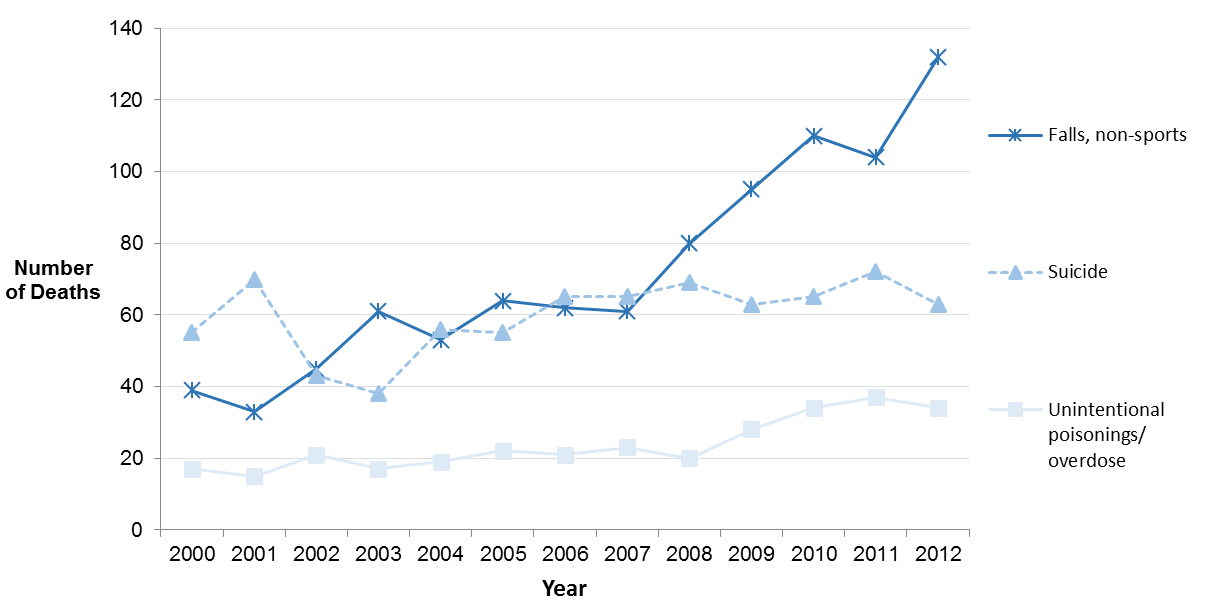
Line chart presenting the number of deaths for the top three leading causes of injury deaths for Ottawa residents, all ages, from 2000 to 2012.

Data Source and Notes for Figure 1

Ontario Mortality Data (2000-2012). Ontario Ministry of Health and Long-Term Care IntelliHealth Ontario. Falls [ICD-10-CA W00-W19]; Suicide [ICD-10-CA X60-X84, Y87.0]; Unintentional poisonings/overdose [ICD-10-CA X40-X49].

  • The data represent deaths for Ottawa residents. The injury event leading to death may have taken place outside of Ottawa.

Data Table for Figure 1

Table 1. Number of deaths due to the top three leading causes of injury deaths for Ottawa residents, all ages, from 2000 to 2012

Year

Falls Deaths

Suicides

Unintentional Poisonings/ Overdose Deaths

2000

39

55

17

2001

33

70

15

2002

45

43

21

2003

61

38

17

2004

53

56

19

2005

64

55

22

2006

62

65

21

2007

61

65

23

2008

80

69

20

2009

95

63

28

2010

110

65

34

2011

104

72

37

2012

132

63

34


In Ottawa:

  • Unintentional and intentional injuries to residents accounted for over 92,200 emergency department (ED) visits in 2017. Approximately 6,600 of these visits were hospitalized. 
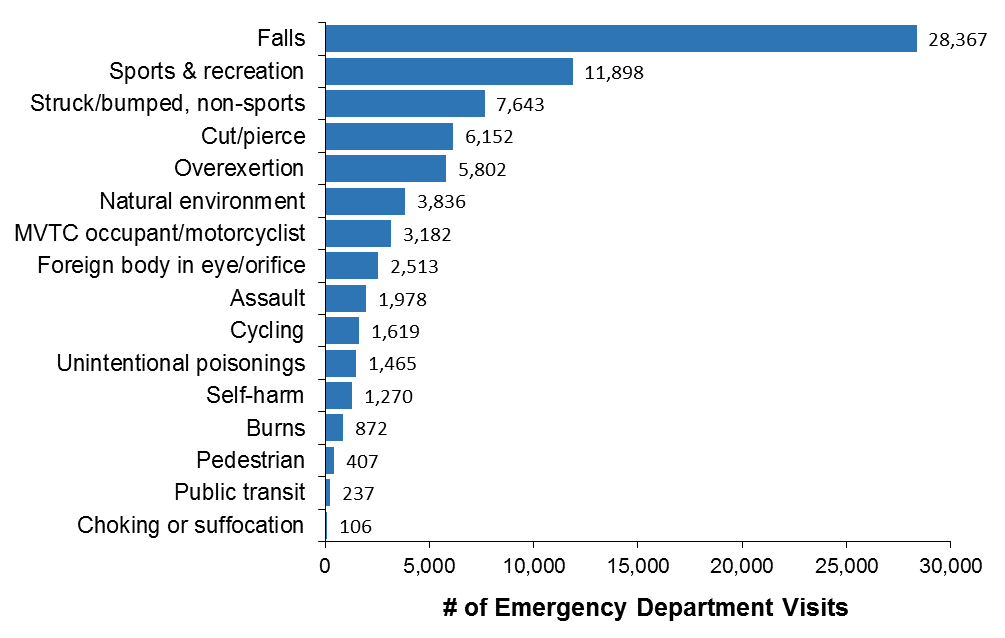
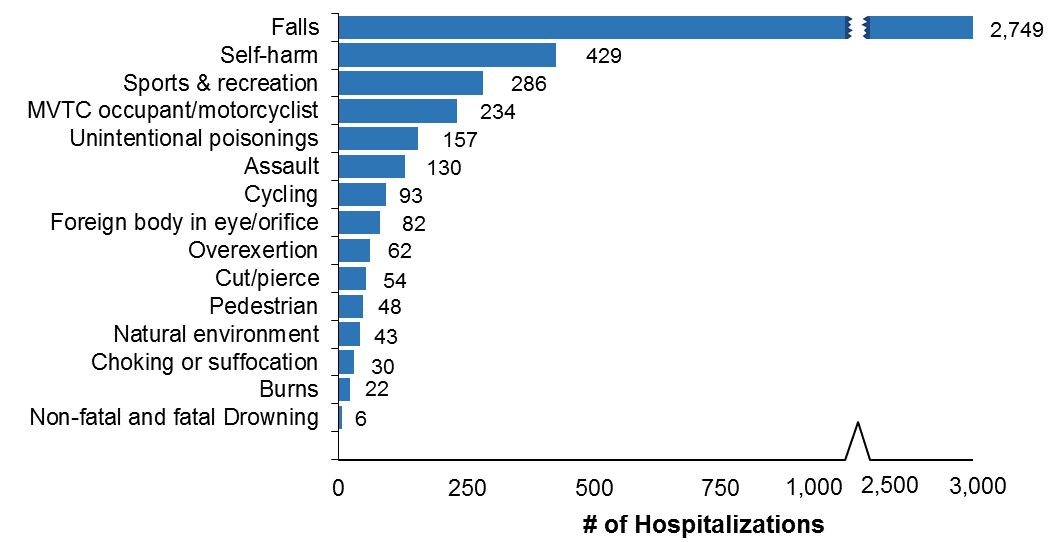
  • Falls were the leading cause of injury-related ED visits (28,367) (Figure 2), hospitalizations (2,749) (Figure 3), and deaths (132). 
  • Falls were the leading cause of injury-related hospitalization in all age groups, with the exception of 15 to 24 year olds (Table 4). Self-harm was the leading cause of injury-related hospitalization for 15 to 24 year olds. 

Figure 2. Leading causes of injury-related emergency department visits for Ottawa residents, all ages, 2017

Horizontal bar chart of the leading causes of injury-related hospitalizations for Ottawa residents, all ages, in 2017

Figure 3. Leading causes of injury-related hospitalizations for Ottawa residents, all ages, 2017

Horizontal bar chart of the leading causes of injury-related emergency department visits for Ottawa residents, all ages, in 2017

Data Source and Notes for Figure 3

Hospitalizations resulting from unscheduled emergency department visits, National Ambulatory Care System (2017). Ontario Ministry of Health and Long-Term Care IntelliHealth Ontario. Extracted June 8, 2018

  • MVTC = Motor vehicle traffic collisions.
  • Not all categories are mutually exclusive and unless stated, some of the injury categories (e.g. cycling, falls, drowning) may overlap with the sport & recreation category.
  • The approach to reporting leading causes of injury here is different from the way others have reported the leading causes of injury.
    • It includes a sport and recreational injury category, utilizing Canadian-specific U99 activity codes for ED and hospitalization data, which are not mandatory in the hierarchy of coding sport and recreational injuries. The U99 activity codes are suggested for use in describing further, the activity of the injured person at the time the event occurred. For example, a person who fell while playing ice hockey would be coded as W00 (Fall on same level involving ice and snow) and U99.011 (Ice hockey). While we have used the U99 codes to tease out sport and recreation specific codes from categories where there is common (>5%) overlap (i.e., falls, overexertion), the categories are not all mutually exclusive. For example, a person who was bitten by a dog and fell while out for a run would be coded as W54 (Bitten or struck by dog), W01 (Fall on same level from slipping, tripping and stumbling) and U99.050 (Running) and would be counted in the sport and recreation and the natural environment categories, but would not be included in the falls, non-sports category.
    • Another difference is that others have defined MVTC as a broader category, whereas we have separate categories for car/van/truck/motorcyclist occupants, pedestrians, public transit/bus/train occupants and cyclists injured in a transport collision.
    • Due to these differences, the rankings should not be compared to other rankings of leading causes of injury morbidity and mortality.
  • The following ICD-10-CA codes were used to categorize the injuries:

ICD-10-CA Codes for External Causes of Injuries

External Cause of Injury

ICD10-CA

All Unintentional Injuries

V01-X59, Y85-Y86. Emergency department and hospitalizations with a code of W75-W84 not accompanied by a main diagnosis of ICD-10-CA S or T are excluded.

Burns

X00-X19, W85-W93

Choking or suffocation

W75-W84 accompanied by a main diagnosis of ICD-10-CA S or T

Cut/pierce

W25-W29, W45-W46

Drowning/near drowning

W65-W74, V90, V92

Falls

W00-W19

Foreign body entering the eye or other orifice

W44

Motor vehicle traffic collisions, car/van/truck/motorcyclist occupant

V20-V69, V83-V85

Natural environment – bitten by animals, reptiles, insects, plants, forces of nature, heat, cold, noise/vibration

W53-W64, W92-W99, W42, W43, W20-39, X51-X57

Overexertion, non-sports

X50. Emergency department visits and hospitalizations accompanied with a code of U99.00-U99.09 are excluded.

Pedestrian

V01-V09

Poisoning/overdose (unintentional)

X40-X49

Public transit (bus, train, streetcar)

V70-V79, V81-V82

Sport and recreational activities

Includes ICD10-CA Chapter XX codes for ATV or snowmobile, baseball, cycling, rollerskate, scooter or skateboard, football or rugby, hockey/ringette, ice skating, playground, including trampoline, pool & natural water swimming, diving/jumping, recreational boating, ski or snowboarding, soccer, tobogganing and all activities coded as U99.00-U99.09 accompanied with a main diagnosis in Chapter XIX (S or T codes) and an unintentional injury code (V01-X59, Y85-Y86).

ATV or Snowmobile

V68, U99.032a, U99.045a

Baseball

W22.05, W21.01, W51.05, U99.010a

Cycling

V10-V19, U99.034a, U99.035a

Rollerskate, scooter or skateboard

W02.02, W02.03, W02.08, U99.036a

Football or rugby

W22.03, W51.03, U99.003 a, U99.004a

Hockey/Ringette

W21.02, W21.03, W22.02, W51.02, U99.011a, U99.012a, U99.013a, U99.014a, U99.016a

Ice skating

W02.00, U99.041a

Playground (excluding trampoline)

W09.0-W09.4, W09.6-W09.9

Toboggan

W22.01, W51.01, U99.043a

Trampoline

W09.05, U99.062a

Pool & natural water swimming, diving/jumping

W16, W67-W74, U99.020a, U99.021a, U99.024, U99.025a, U99.028a, U99.029a

Recreational boating

V90.2-V90.8, V91.2-V91.8, V92.2-V92.9, U99.022a, U99.030a, U99.031a, U99.085a

Ski or snowboard

W02.01, W02.04, W22.00, W51.00, U99.040a, U99.044a

Soccer

W22.04, W51.04, U99.002a

Struck/bumped by object/person, non-sports

W20.00, W22.08, W22.09, W50.00, W51.08, W51.09, W52

Intentional injuries


Self-harm

X60-X84, Y87.0

Assault

X85-X99, Y00-Y09, Y87.1

a “U” codes included only if accompanied with a “S” or “T” code from Chapter XIX. U codes were available for ER visits and hospitalizations only.

Data Table for Figure 3

Table 3. Leading causes of injury-related hospitalizations for Ottawa residents, all ages, 2017

Injury Type

Number of Hospitalizations

Falls

2749

Self-harm

429

Sports & recreation

286

MVTC occupant/motorcyclist

234

Unintentional poisonings

157

Assault

130

Cycling

93

Foreign body in eye/orifice

82

Overexertion

62

Cut/pierce

54

Pedestrian

48

Natural environment

43

Choking or suffocation

30

Burns

22

Non-fatal and fatal drowning

6

Table 4. Leading causes of injury-related hospitalizations, presented as counts with rates per 100,000 population in brackets, for Ottawa residents by age groups, 2017

Rank

0 to 4 Years Old

5 to 14 Years Old

15 to 24 Years Old

25 to 44 Years Old

45 to 64 Years Old

65+ Years Old

1

Falls

60 (113.0)

Falls

109 (104.1)

Self-harm

187 (143.1)

Falls

117 (40.3)

Falls

375 (140.5) 

Falls

2030 (1342.6) 

2

Sport & recreation

12 (22.6)

Sport & recreation

98 (93.6)

Falls

58 (44.4)

Self-harm

115 (39.6)

Self-harm

91 (34.1%)

MVTC, car/van/ truck/motorcycle occupant

57 (37.7)

3

Foreign body entering eye/orifice

10 (18.8)

Cycling

15 (14.3)

Sport & recreation

47 (36.0)

Assault

62 (21.4)

Sport & recreation

89 (33.3)

Struck/ bumped by object/person

37 (24.5)

4

Unintentional poisoning / overdose

8 (15.1) 

Self-harm

13 (12.4)

MVTC, car/van/ truck/motorcycle occupant

40 (30.6)

MVTC, car/van/ truck/motorcycle occupant

62 (21.4) 

MVTC, car/van/ truck/motorcycle occupant

73 (27.3)

Sport & recreation

32 (21.2)

5

Struck/ bumped by object/person

7 (13.2)

Foreign body entering eye/orifice

12 (11.5) 

Assault

39 (29.9)

Unintentional poisoning / overdose

45 (15.5)

Unintentional poisoning / overdose

42 (15.7)

Unintentional poisoning / overdose

28 (18.5)

Total

All injuries

142 (267.4)

All injuries

241 (230.3)

All injuries

533 (408.0)

All injuries

840 (289.5)

All injuries

1487 (557.1)

All injuries

3358 (2221.0)

Data Source and Notes for Table 4

Hospitalizations resulting from unscheduled emergency department visits, National Ambulatory Care System (2017). Ontario Ministry of Health and Long-Term Care IntelliHealth Ontario. Extracted June 8, 2018. 

  • MVTC = Motor vehicle traffic collisions.
  • Not all categories are mutually exclusive and unless stated, some of the injury categories (e.g. cycling, falls, drowning) may overlap with the sport & recreation category.
  • The counts provided include all Ottawa residents seen at emergency departments and subsequently hospitalized in Ontario. Please note that injury events may have taken place outside of Ottawa.
  • The approach to reporting leading causes of injury here is different from the way others have reported the leading causes of injury.
    • It includes a sport and recreational injury category, utilizing Canadian-specific U99 activity codes for ED and hospitalization data, which are not mandatory in the hierarchy of coding sport and recreational injuries. The U99 activity codes are suggested for use in describing further, the activity of the injured person at the time the event occurred. For example, a person who fell while playing ice hockey would be coded as W00 (Fall on same level involving ice and snow) and U99.011 (Ice hockey). While we have used the U99 codes to tease out sport and recreation specific codes from categories where there is common (>5%) overlap (i.e., falls, overexertion), the categories are not all mutually exclusive. For example, a person who was bitten by a dog and fell while out for a run would be coded as W54 (Bitten or struck by dog), W01 (Fall on same level from slipping, tripping and stumbling) and U99.050 (Running) and would be counted in the sport and recreation and the natural environment categories, but would not be included in the falls, non-sports category.
    • Another difference is that others have defined MVTC as a broader category, whereas we have separate categories for car/van/truck/motorcyclist occupants, pedestrians, public transit/bus/train occupants and cyclists injured in a transport collision.
    • Due to these differences, the rankings should not be compared to other rankings of leading causes of injury morbidity and mortality.
  • The following ICD-10-CA codes were used to categorize the injuries:

ICD-10-CA Codes for External Causes of Injuries

External Cause of Injury

ICD10-CA

All Unintentional Injuries

V01-X59, Y85-Y86. Emergency department and hospitalizations with a code of W75-W84 not accompanied by a main diagnosis of ICD-10-CA S or T are excluded.

Burns

X00-X19, W85-W93

Choking or suffocation

W75-W84 accompanied by a main diagnosis of ICD-10-CA S or T

Cut/pierce

W25-W29, W45-W46

Drowning/near drowning

W65-W74, V90, V92

Falls

W00-W19

Foreign body entering the eye or other orifice

W44

Motor vehicle traffic collisions, car/van/truck/motorcyclist occupant

V20-V69, V83-V85

Natural environment – bitten by animals, reptiles, insects, plants, forces of nature, heat, cold, noise/vibration

W53-W64, W92-W99, W42, W43, W20-39, X51-X57

Overexertion, non-sports

X50. Emergency department visits and hospitalizations accompanied with a code of U99.00-U99.09 are excluded.

Pedestrian

V01-V09

Poisoning/overdose (unintentional)

X40-X49

Public transit (bus, train, streetcar)

V70-V79, V81-V82

Sport and recreational activities

Includes ICD10-CA Chapter XX codes for ATV or snowmobile, baseball, cycling, rollerskate, scooter or skateboard, football or rugby, hockey/ringette, ice skating, playground, including trampoline, pool & natural water swimming, diving/jumping, recreational boating, ski or snowboarding, soccer, tobogganing and all activities coded as U99.00-U99.09 accompanied with a main diagnosis in Chapter XIX (S or T codes) and an unintentional injury code (V01-X59, Y85-Y86).

ATV or Snowmobile

V68, U99.032a, U99.045a

Baseball

W22.05, W21.01, W51.05, U99.010a

Cycling

V10-V19, U99.034a, U99.035a

Rollerskate, scooter or skateboard

W02.02, W02.03, W02.08, U99.036a

Football or rugby

W22.03, W51.03, U99.003 a, U99.004a

Hockey/Ringette

W21.02, W21.03, W22.02, W51.02, U99.011a, U99.012a, U99.013a, U99.014a, U99.016a

Ice skating

W02.00, U99.041a

Playground (excluding trampoline)

W09.0-W09.4, W09.6-W09.9

Toboggan

W22.01, W51.01, U99.043a

Trampoline

W09.05, U99.062a

Pool & natural water swimming, diving/jumping

W16, W67-W74, U99.020a, U99.021a, U99.024, U99.025a, U99.028a, U99.029a

Recreational boating

V90.2-V90.8, V91.2-V91.8, V92.2-V92.9, U99.022a, U99.030a, U99.031a, U99.085a

Ski or snowboard

W02.01, W02.04, W22.00, W51.00, U99.040a, U99.044a

Soccer

W22.04, W51.04, U99.002a

Struck/bumped by object/person, non-sports

W20.00, W22.08, W22.09, W50.00, W51.08, W51.09, W52

Intentional injuries


Self-harm

X60-X84, Y87.0

Assault

X85-X99, Y00-Y09, Y87.1

a “U” codes included only if accompanied with a “S” or “T” code from Chapter XIX. U codes were available for ER visits and hospitalizations only.

Welcome to the new OttawaPublicHealth.ca

Ottawa Public Health has moved to a refreshed website. During this transition, some links, redirects, documents, pages or display features may be temporarily affected.

Your feedback will help us review and address issues during the stabilization period.