This website uses cookies to enhance usability and provide you with a more personal experience. By using this website, you agree to our use of cookies as explained in our Privacy Policy.
Welcome to our new website!
All of our Ottawa Public Health and Parenting in Ottawa web content can now be found in one place. We hope you find the website easier to navigate. It's now as easy to use on your smartphone as your desktop. We expect there will be some issues during the first few weeks we launch, like broken links or PDF documents, so please connect with us and let us know.
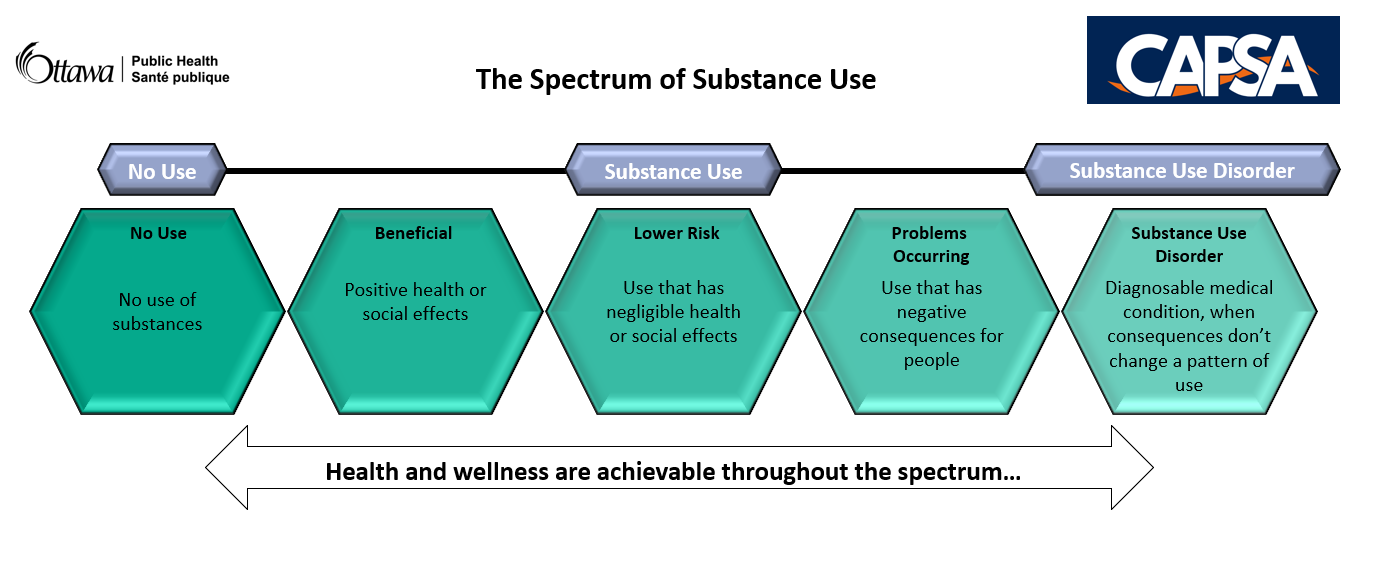
The Spectrum of Substance Use was developed through a partnership between Ottawa Public Health (OPH) and the Community Addictions Peer Support Association (CAPSA), as a tool to help all of us talk about our substance use health. It has evolved and may continue to evolve in the coming years to accommodate new information, as research in this area continues to emerge.
The spectrum includes no use, substance use and the development of a Substance Use Disorder. It is based on the evidence we currently have on substance use and addiction. However, it is not linear and is not meant to read as a process, where a person progresses from one stage to another. But rather, it presents different options and people can identify with different points on the spectrum at anytime. It is meant to be inclusive of everyone - those who consume substances and those who do not. Anyone should be able to identify themselves within the spectrum on any given day.
Spectrum of Substance Use
Please use the following citation for referencing: Ottawa Public Health & Community Addictions Peer Support Association. (2021). Spectrum of Substance Use Health. Ottawa Public Health 2019-2022 Strategic Plan.
Developed through a partnership between OPH and CAPSA, the spectrum of SUH is a tool to help all of us talk about our substance use health.
There are many reasons why someone might wish to not consume substances (i.e. cultural considerations, athletic training, etc.)
One thing we can do is be allies to people and not make them feel uncomfortable if they choose not to consume. It can be very difficult for people to say no and refuse, and if they do, we can support them by:
Respecting their choices,
Not commenting or questioning them,
Backing them when they are being questioned or pestered by someone else, etc.
We encourage everyone to explore and practice ways of saying no that feel authentic to them.
Examples of refusal techniques include:
Saying "No Thanks" plainly and confidently – simple but effective, the “no thanks” technique without a lot of arguing and explaining is often the best and easiest response.
Changing the subject or suggesting a different activity - by thinking of something else to do, you are also offering other people an “out.” You might be surprised who might take you up on it.
Use humor or make a joke - sometimes a witty one-liner or well-timed joke can lighten a serious mood and help deflect the attention.
Make an excuse or give a reason why you cannot participate. Sometimes backing up the “no” with evidence can give it more power (I.e. you can state a health problem or say that it will interfere with your sports training)
Walk away - if all else fails (and you can do so safely), remove yourself from the situation that is making you uncomfortable
And if you are looking for tips on having conversations with youth about refusal skills, here is a great resource for youth: Youth Connections Ottawa
The beneficial use of substances results in positive health or social outcomes, for example:
The use of prescription or non-prescription medications, as directed, for pain management
The symbolic use of substances during religious services or spiritual ceremonies
There are important considerations that come with the beneficial use of substances (i.e. safe storage and disposal of the substance, proper handling, potential side effects, etc).
Problems can occur when consuming a substance, but people do not choose to consume substances in a problematic way, but rather they start to notice problems occurring with their substance use. This could look like:
Unintentionally hurting oneself or others while under the influence of a substance
The use of a substance interfering with a parent’s ability to respond to their child’s needs
Substance Use Disorders are treatable medical conditions, not a moral failing, and certainly not a choice.
Like for other medical conditions, there are many complex health and social factors that contribute to the development of Substance Use Disorders
What tends to get overlooked is that treatment and preventative measures for Substance Use Disorders are effective. Generally as successful as treatments for other chronic medical conditions.
Recovery is possible and attainable! Hope and compassion go a long way in supporting those who are struggling.
Addiction refers to a complex medical condition that involves changes to brain circuitry resulting in altered functioning of a person’s reward, motivation, stress, and executive function systems
Addictions can be linked to certain behaviors (such as gambling), while SUDs are very specific to substances
Addictions are characterized by the four “C”s:
Use becomes Compulsive
Continues despite harmful Consequences
Is accompanied by Cravings
And a sense of loss of Control
If any or all of the four Cs resonate with you about a particular area of your life it is a sign of strength to reach out for help or to speak to your health care provider.
Welcome to the new OttawaPublicHealth.ca
Ottawa Public Health has moved to a refreshed website. During this transition, some links, redirects, documents, pages or display features may be temporarily affected.
Your feedback will help us review and address issues during the stabilization period.