
- A person is not participating in any gambling activities.
- There are many reasons why someone might wish to not gamble (i.e. financial goals, cultural considerations, etc.)
- In recent years, smartphones and online platforms have made gambling more accessible than ever.
- It can be hard to avoid or turn down opportunities to participate, especially in social settings.
- One thing we can do is be allies to people and not make them feel uncomfortable if they choose not to gamble. It can be very difficult for people to say no and refuse, and if they do, we can support them by:
- Respecting their choices,
- Not commenting or questioning them,
- Backing them when they are being questioned or pestered by someone else, etc.
Gambling
Last revised: October 28, 2025
Gambling is when you bet money or valuables to win something of greater value, but you don’t know if you will win or lose.
Gambling activities include slot machines, lottery tickets, bingo and casino games like blackjack or poker. Gambling does not only occur at Casinos and Racetracks. In recent years, the rise of smartphones and internet platforms have made online gambling more accessible than ever (i.e. betting on sports and online casino games). Gambling can also often occur in online video games when players buy loot boxes (which contain randomized items) with real-world money.
Our relationship with Gambling can be influenced by many factors. Some people gamble as a form of entertainment, others as a social activity. The use of substances can also have an impact on the way that we gamble.
Gambling behavior can be understood on a continuum.
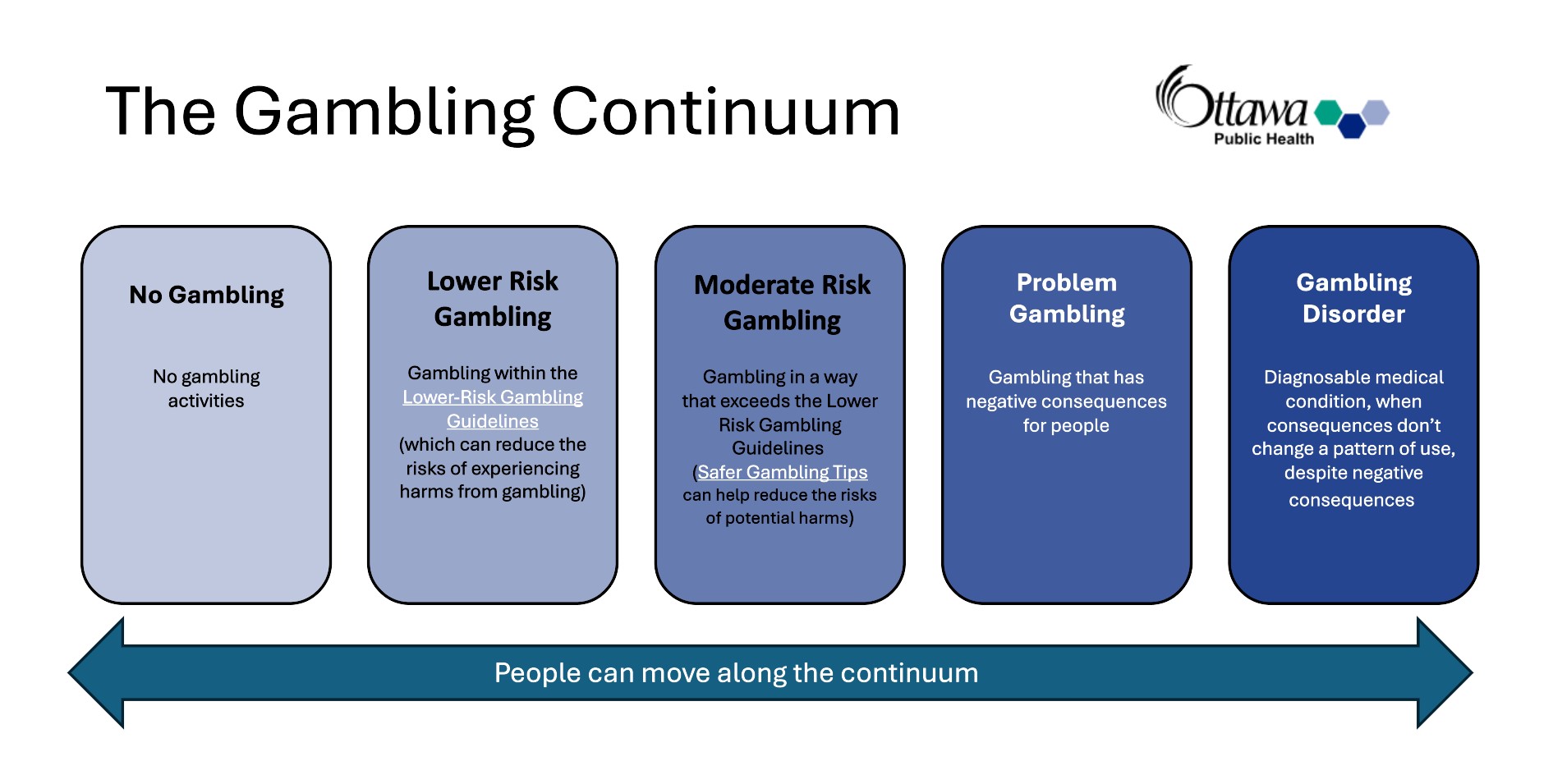
- Gambling is a common activity. Most Canadians will participate in a form of gambling of some kind, in their lifetime, often without experiencing serious harms. For example:
- Buying a lottery ticket from time to time
- Playing Bingo
- Participating in a 50/50 raffle
- Placing a bet with friends on the outcome of a large sporting event
- However, gambling has the potential to cause harms, even when only gambling occasionally or for fun or entertainment.
- If someone chooses to gamble, remaining within the Lower-Risk Gambling Guidelines can help them lower their risk of experiencing harms related to gambling:
- Limit your gambling activities: Avoid regularly gambling at more than 2 types of games
- Limit your time gambling: Gamble no more than 4 days per month
- Limit money spent on gambling: Gamble no more than 1% of household income. It can be hard to figure out what 1% of your annual (yearly) income means, but this quick tip can help!
Quick Tip: If you know your weekly income, you can use this formula to determine the recommended monthly gambling spending limit: (My Weekly Income) x 0.01 = [recommended gambling spending limit per month]
Example: If you make $192.31 a week
$192.31 x 0.01 = 1.92
This means that the recommended gambling spending limit for the month would be $1.92.
Example: If you make $769.23 a week
$769.23 x 0.01 = $7.69
This means that the recommended gambling spending limit would be $7.69.
Here are a few more examples:
|
$100.00 per week |
$1.00 per month |
|
$200.00 per week |
$2.00 per month |
|
$250.00 per week |
$2.50 per month |
|
$500.00 per week |
$5.00 per month |
|
$750.00 per week |
$7.50 per month |
|
$1000.00 per week |
$10.00 per month |
|
$1250.00 per week |
$12.50 per month |
|
$1500.00 per week |
$15.00 per month |
- Even in moderation, gambling can have an impact on our wellbeing.
- There are ways of gambling that can reduce our health, financial and social risks.
- Setting limits on the amount of time and money spent on gambling is one of the most effective ways of preventing harms.
- If someone chooses to gamble beyond the Lower-Risk Gambling Guidelines, the Safer Gambling Tips can help reduce your risks of potential harms related to gambling.
- Gambling becomes a problem when you have trouble stopping.
- The intermittent rewards of gambling affect our brains by releasing dopamine, which can make us feel excited. For some people, this effect on the brain can make it very difficult to stop gambling, which can result in serious harms.
- People do not choose to gamble in a problematic way, but they may start to notice problems occurring in their life as a result of gambling. For example:
- While on their way home from work, a person stops at a local casino. This person may have had a stressful day at work and wants to play a few rounds on the slot machines to unwind. While playing on the slot machines, the person loses track of the time and consequently is late picking up their children from daycare.
- During a night out with friends, a young person places bets on elements of a televised sports event of their favorite team. Having lost their first few bets, the young person becomes frustrated and, in an attempt, to win back the money they lost, they decide to place more bets on the events of the game using the money they saved for this month's rent. Unfortunately, by the end of the night, the young person has lost most or all the money they bet with and no longer has the means to pay their rent.
- Are you wondering whether you, or someone you know, may have a problem with gambling? Take this quiz to find out.
- Supports are available in our community: Mental Health and Substance Use Resource List
- Gambling Disorder is a treatable medical condition, not a choice or a moral failing.
- It is diagnosed when a person can no longer change their gambling behaviors despite the negative consequences.
- Like other medical conditions, there are many complex health and social factors that contribute to the development of a Gambling Disorder.
- Treatment and preventative measures for Gambling Disorders are effective. Recovery is possible and attainable!
- For more information on supports available in our community: Mental Health and Substance Use Resource List
To learn more about Addiction, visit have THAT talk About Substance Use Health - Ottawa Public Health.
Some people can limit their time and money spent gambling, which can reduce their risk of experiencing negative effects or harms from gambling.
Some people are more at risk of developing problems with gambling. Learn more about the effects of gambling on our brains and the factors that can contribute to problem gambling.
If a person has trouble limiting time or money, it may be a problem. As time and money spent on gambling increases, the person can experience more severe harms.
Stigma around gambling problems can keep people from getting the help they need. It can make a person feel alone and without support.
If you choose to gamble, it is important to know how gambling works and what the chances of winning actually are. For example, odds of winning the lottery jackpot are 1 in 33,294,800.
Gambling rarely results in winning. Casinos and gambling platforms have a built-in advantage to ensure they always make a profit. This is often called the “House Edge”.
It helps to Know your odds.
For more information, please visit All About Gambling.
There is growing use of micro-transactions in video games - often referred to as ‘loot boxes’, ‘skins’ or mystery prizes - which can be a type of gambling.
Here is a list of some gambling features frequently found in video games:
- The player needs to purchase the prize
- It is hard to understand how much money is needed to buy the prize as the credits in the game are different from the dollar amounts; 1500 credits = $24.99
- The prize is unknown; generated randomly
- Some prizes give an in-game advantage while others do not
- Prizes are advertised in the game with pressure tactics, ‘on sale now’, ‘limited time offer’, ‘buy now’
- Contents of “Loot Boxes” can be sold for real money on secondary websites. Learn more about how "Loot Boxes” work by visiting: Is Loot box Unlocking Gambling?
Gambling has the potential to cause harms of various kinds (i.e. financial strain, psychological and emotional distress, relationship breakdown, negative health impacts and thoughts of suicide) that can impact individuals and their families. Learn more about the potential harms that can be caused by Gambling.
If you or someone you know is in distress, crisis lines are available.
For a full list of Mental Health and Substance Use Services in Ottawa please visit our Mental Health and Substance Use Resource List webpage.
If you choose to gamble, you can reduce your risk of harms by applying the three guidelines outlined in the Lower-Risk Gambling Guidelines.
Here are a few more tips:
- Set a budget, like what you might spend on other entertainment, do not use grocery or rent money.
- Set a time limit, some gambling games are designed so that you lose track of time.
- Don’t think of gambling as a way to make money, the odds are you will lose money in the long run.
- Balance gambling with other activities.
- Limit alcohol and other substances when gambling.
- Don’t borrow money to gamble.
For more information on how to make gambling safer, please visit the Responsible Gambling Council website.
Not all gambling is a problem. But for some people, gambling may become a serious problem that affects their finances, their family, work and their mental and physical health.
Gambling Disorder develops when a person can no longer change their gambling behaviors despite the negative consequences.
There are many reasons why a gambling problem may develop. For example, some people develop problems when they try to win back money they have lost, while others may use gambling as a way to cope with the heavy stresses in their life. Many other factors can contribute as well.
People from all age groups, income groups, and cultures can experience problems with gambling. Gambling problems can begin suddenly for some, while for others they may develop over the course of many years.
Warning signs of problem gambling
There are usually no visible signs or physical changes that will indicate a gambling problem, but there are some common behavioural, emotional, health and financial signs of problem gambling. Here is a quick checklist of some of the signs of problem gambling:
- Gambling to escape other worries.
- Playing longer than expected or planned.
- Missing work, school, family events because of gambling.
- Gambling with money meant for essentials like food or rent/mortgage.
- Borrowing money to gamble or pay off gambling debts.
- Promising to stop gambling, but continuing to play.
- Experiencing mood or personality changes as gambling continues.
- Experiencing thoughts of suicide due to gambling.
For more warning signs and other information on signs that gambling has become a problem, please visit the Problem Gambling website.
A number of risk factors can contribute to the development of gambling problems or make it more difficult to stop. People are more at risk if they:
- Have an early big win (leading to false expectation of future wins).
- Have easy access to their preferred form of gambling.
- Hold mistaken beliefs about the odds of winning.
- Do not take steps to monitor gambling wins and losses.
- Have had a recent loss or change, such as divorce, job loss, retirement or death of a loved one.
- Often feel bored or lonely, or have a history of risk-taking or impulsive behaviour.
- Have a history of mental health challenges, particularly depression and anxiety.
- Tie their self-esteem to gambling wins or losses.
- Have family members who have experienced Problem Gambling or been diagnosed with a Gambling Disorder
Adapted from the Centre for Addiction and Mental Health (CAMH)’s Problem Gambling webpage: Problem Gambling
The nature and frequency of someone’s gambling can be affected by:
- Their environment (i.e. living close to casinos or other establishments where gambling takes place)
- The culture they grew up in (i.e. someone’s exposure to gambling, the attitudes of those around them to gambling)
- Their access to resources (i.e. someone’s access to prevention programs or tools to assess the risk of gambling products)
To learn more about the factors that can contribute to a Gambling Disorder visit: The Science Behind Gambling
In Ontario, you must be 18 to play the lottery or bingo, and 19 to gamble at casinos. Some online gambling sites follow these rules, but others don’t check for age.
Children are seeing more gambling in social media and online ads. Some video games also include features that are like casino games.
About one-quarter (24%) of students report gambling while playing a video game in the past year (that is, spent real money to buy loot boxes, keys or in-game currency, or engaged in skins betting).
Learn more about Gambling. Talking with Your Youth About Sports Betting.
Worried about someone's gambling?
Here are a few tips to consider before talking to the person:
- Bring up your concerns when they are already talking about gambling or their regrets of doing it.
- Express your concerns with “I” phrases like “I feel” or “I think”.
- Stay calm when you are speaking with them.
- Be clear about your worries and what you are asking the person to do to help the situation.
- Remember that gambling is only one part of the person’s life and focus on their good qualities.
- Have a support system in place such as a friend or counsellor.
For more tips on how to talk to a friend or loved one about gambling, check out Sports Betting & Online Gambling: Know your odds.
Are you wondering if you, or someone you know, has a problem with gambling? Fill out this quiz and find out!
Do you think your gambling may have become a problem? There is help available.
Admitting to having a problem with gambling can be hard. It can also be difficult to understand how someone else's gambling got out of control. Hearing stories from those that have lived it may help.
Joe's story on Recovery:
James' Story on Recovery:
We would like to thank everyone in the videos who are helping others find support by sharing their own story.
Ottawa Public Health would also like to thank the Responsible Gambling Council for all their work in putting together these stories of recovery.
The Ottawa Gambling Harm Prevention Network (OGHPN) is part of a four-point plan accepted by the Ottawa Board of Health from the report called: A Public Health Approach to Reducing Harms from Gambling in Ottawa.
The mission of the OGHPN is to work together with partners to raise awareness of the harms around gambling, to help people make better decisions about gambling and to develop plans to prevent gambling harms in Ottawa.
If you think you or someone you know is experiencing problem gambling, help is available. All services are free and confidential.
Ottawa residents can call:
- ConnexOntario provides confidential support and information about local counselling services for individuals with gambling problems and their families and friends. Contact through live chat, email, or call 1-866-531-2600.
- AccessMHA, a simple new single point of entry to eastern Ontario’s system of care for mental health and addictions.
Prevention and treatment service providers available in Ottawa:
- Amethyst Women's Addiction Centre 613-563-0363
- Centertown Community Health Centre hosts the Lifestyle Enrichment For Senior Adults (LESA) 613-233-4443
- Credit Canada is a not-for-profit agency providing free credit counselling and education, as well as confidential debt help, debt consolidation, and debt repayment programs 1-800-267-2272 or email info@creditcanada.com
- Gamblers Anonymous and Gam-Anon 613-567-3271
- Residential Program Problem Gambling and Digital Dependency, 21-day Problem Gambling treatment program in Windsor, Ontario 519-254-2112
- Rideauwood Addiction and Family Services 613- 724-4881
- Sandy Hill Community Health Centre 613-789-1500
- Self exclusion from Ottawa and Gatineau casinos is available at Sandy Hill Community Health Centre
Welcome to the new OttawaPublicHealth.ca
Ottawa Public Health has moved to a refreshed website. During this transition, some links, redirects, documents, pages or display features may be temporarily affected.
Your feedback will help us review and address issues during the stabilization period.